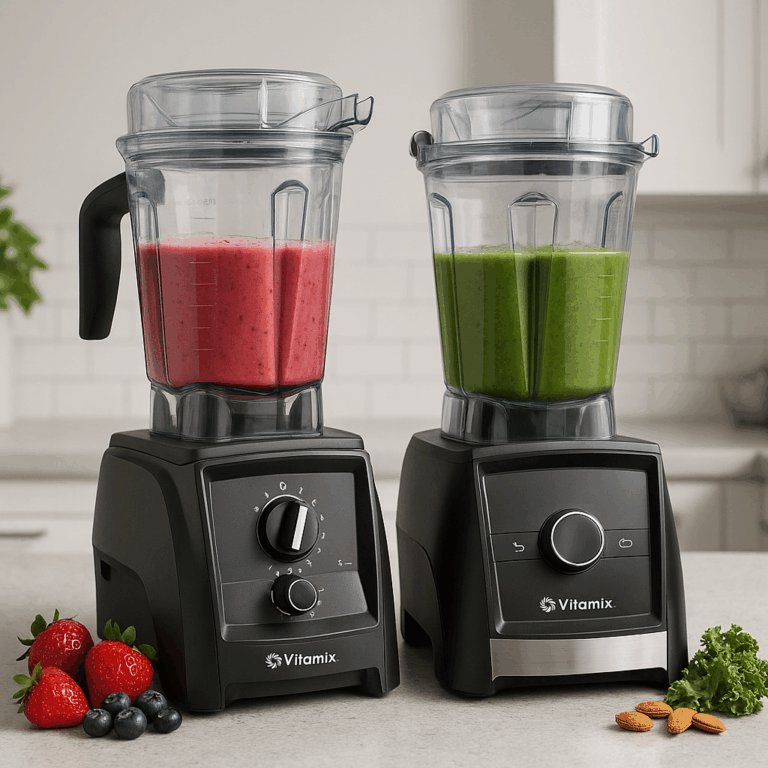
People comparing the Vitamix 5200 and the Blendtec Total Classic usually agree on one thing.
They want a serious blender.
They are not shopping for entry-level appliances.
They are not impressed by marketing wattage alone.
They expect smooth textures, durability, and daily reliability.
What they are unsure about is how much control they actually want while blending.
Both blenders are powerful.
Both are trusted by professionals.
Both can handle smoothies, meal prep, and fitness routines.
Yet they feel very different to live with.
This article exists to make that difference impossible to miss.
Before narrowing in on these two models, it helps to understand how high-performance blenders are designed around different usage patterns. This overview of how professional-grade blenders fit into everyday kitchen routines provides helpful context.
Table of Contents
These Two Blenders Solve the Same Goal in Opposite Ways
The Vitamix 5200 and Blendtec Total Classic are not “better” and “worse.”
They represent two philosophies of blending.
Vitamix prioritizes:
- Manual control
- Gradual power delivery
- Texture precision
- Long-term mechanical reliability
Blendtec prioritizes:
- Automation
- High-speed blending
- Push-button convenience
- Minimal learning curve
Both approaches work.
Only one will feel right for your habits.
Advertised Horsepower Is Not the Real Performance Difference
Blendtec advertises a 3.0 HP motor.
Vitamix lists the 5200 at roughly 2.0 HP.
On paper, that looks decisive.
In practice, it is not.
Real-world performance depends on:
- Torque delivery
- Speed control
- Jar geometry
- Blade interaction
- Heat management
Both blenders can:
- Crush ice easily
- Blend frozen fruit
- Handle leafy greens
- Run daily without strain
The difference is how you manage the blend, not whether it finishes.
Why Manual Speed Control Changes Texture Outcomes
The Vitamix 5200 uses a variable speed dial with a pulse switch.
This allows you to:
- Start slow
- Increase speed gradually
- Stop exactly when the texture is right
- Prevent air pockets
- Blend with minimal liquid
This matters most when making:
- Thick smoothies
- Meal replacement shakes
- Nut-based blends
- Seed-heavy recipes
- Fiber-dense green smoothies
The tall jar design creates a strong vortex, but it requires user input. Over time, most owners learn how small speed changes affect results.
This learning curve pays off with consistent, repeatable textures.
Why Preset Programs Feel Easier at First
The Blendtec Total Classic removes most decision-making.
You:
- Load ingredients
- Press a button
- Walk away
Preset cycles control:
- Speed
- Duration
- Pulsing
This is appealing when:
- Multiple people use the blender
- Mornings are rushed
- Recipes are simple
- Consistency matters more than customization
For fruit smoothies, protein shakes, and ice-based drinks, Blendtec performs extremely well with minimal effort.
The tradeoff is less control over the final texture, especially in thicker blends.
Smoothie Quality Is About Consistency, Not Speed
Both blenders make smooth smoothies.
The difference appears with:
- Greens
- Seeds
- Oats
- Thick protein powders
The Vitamix 5200 consistently produces:
- Creamier textures
- Fewer unbroken fibers
- Less foam
- Better mouthfeel in thick blends
Blendtec smoothies are smooth, but often:
- Slightly foamier
- More dependent on the liquid ratio
- Less forgiving with dense ingredients
If smoothies are occasional, this difference may not matter.
If smoothies are daily, it matters a lot.
Meal Prep and Fitness Shakes Reveal the Gap
Meal prep blends stress a blender more than fruit smoothies.
They involve:
- Thicker textures
- Less liquid
- Longer blend times
- Heat buildup
The Vitamix 5200 handles these conditions better because you can:
- Keep speeds moderate
- Avoid overheating
- Use the tamper to maintain circulation
- Stop blending before overprocessing
Blendtec can make meal shakes, but often requires:
- Restarting cycles
- Adding extra liquid
- Scraping the jar
For fitness-focused users, this difference becomes noticeable within weeks.
Daily Ownership Feels Very Different Over Time
Specs fade quickly.
Habits do not.
With Vitamix:
- You become more involved
- You learn your recipes
- You adjust by feel
- You gain confidence over time
With Blendtec:
- Blending stays hands-off
- Results are predictable
- There is a little learning curve
- You rely on automation
People who enjoy cooking often prefer Vitamix.
People who want blending to disappear prefer Blendtec.
Neither is wrong.
Mismatch causes regret.
Jar and Blade Design Influence Workflow
Vitamix uses:
- A tall, narrow jar
- Sharp stainless-steel blades
- A tamper for thick blends
This design:
- Excels at dense mixtures
- Requires active involvement
- Needs cabinet height clearance
Blendtec uses:
- A wide WildSide+ jar
- Blunt blades
- No tamper
This design:
- Is easier to load
- Is easier to clean
- Fits under more cabinets
- Handles liquids well
Workflow preference matters more than blade sharpness.
Cleaning and Maintenance Over Years of Use
Both blenders are easy to clean day-to-day.
Add warm water.
Add soap.
Run briefly.
Long-term ownership differs.
Vitamix’s mechanical simplicity:
- Ages well
- Has fewer electronic failure points
- Tolerates heavy use
Blendtec’s electronics:
- Add convenience
- Require more care around moisture
- Are protected by a longer warranty
For users who want to minimize maintenance concerns, this broader breakdown of how blending control styles and automation levels influence long-term reliability across high-performance blender models provides a helpful ownership perspective.
Ingredient Performance Highlights the Philosophies
Leafy Greens and Seeds
Vitamix breaks down fibrous ingredients more completely.
Blendtec may leave trace particles unless extra liquid is used.
Frozen Fruit and Ice
Blendtec crushes ice faster.
Vitamix handles frozen fruit better in thick blends.
Nut Butters and Hummus
Vitamix clearly performs better due to manual control and tamper use.
Blendtec can do it, but with more stopping and scraping.
Ease of Use Is About Confidence, Not Intelligence
Blendtec is easier for beginners.
Vitamix rewards experience.
If you want:
- Zero thinking
- Consistent automation
- Shared household use
Blendtec fits better.
If you want:
- Custom textures
- Recipe flexibility
- Cooking versatility
Vitamix fits better.
Noise Is Situational, Not Absolute
Both blenders are loud.
Vitamix allows:
- Mid-speed blending
- Lower noise for light tasks
Blendtec:
- Often runs full speed
- Is louder during presets
In apartments or early mornings, Vitamix offers more flexibility.
Durability, Warranty, and Long-Term Value
Vitamix blenders are famous for longevity. Many last over a decade.
Blendtec offers:
- Excellent customer support
- An 8-year warranty
- Strong brand reputation
Vitamix offers:
- Mechanical reliability
- Fewer electronic dependencies
- Strong resale value
If you plan to keep a blender long-term, Vitamix has an edge.
If you value warranty coverage and convenience, Blendtec is compelling.
Kitchen Space and Storage Are Not Minor Details
The Vitamix 5200 is tall.
It may not fit under cabinets.
Blendtec’s shorter jar fits more easily.
This alone eliminates Vitamix for some kitchens.
Measure before deciding.
Who Should Choose Each Blender
Choose the Vitamix 5200 if you:
- Make thick smoothies or meal prep blends
- Use high-fiber ingredients
- Want precise texture control
- Blend daily
- Value long-term durability
Choose the Blendtec Total Classic if you:
- Want fast, automated blending
- Share the blender with others
- Make mostly fruit smoothies
- Have limited cabinet space
- Prefer minimal learning curve
For deeper ownership insight, these hands-on reviews expand on long-term use:
- What daily life with the Vitamix 5200 feels like for frequent smoothie and meal prep users
- How the Blendtec Total Classic performs for hands-off, preset-driven blending routines
Questions That Still Matter Before Choosing
Is Vitamix better for thick smoothies?
Yes. Manual speed control and the tamper make a real difference.
Does Blendtec crush ice faster?
Yes. Presets and high speed excel with ice.
Which is quieter overall?
Vitamix is easier to manage quietly due to speed control.
Which blender lasts longer?
Vitamix often lasts longer mechanically. Blendtec offers longer warranty coverage.
Which is better for beginners?
Blendtec is easier out of the box.
Final Buying Reality Check
Do not choose based on horsepower.
Choose based on:
- How often do you blend
- How thick are your recipes
- Whether you enjoy control
- Whether convenience matters more
Both blenders are excellent.
Only one will feel effortless for you.
Final Verdict: Vitamix 5200 or Blendtec Total Classic?
Choose the Vitamix 5200 if blending is part of how you cook, prep, and fuel your body.
Choose the Blendtec Total Classic if blending should be fast, automatic, and low-effort.
The wrong choice still blends.
The right choice fits your life.