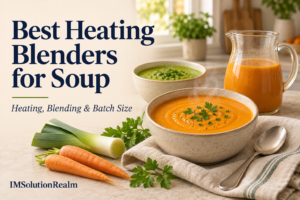
A blender that heats soup, a soup maker that cooks ingredients, and a blender approved for hot liquids can serve different purposes. Understanding that difference matters more than choosing the machine with the most power.
Our recommendations focus on three friction-heating options. The Vitamix Propel 510 offers a smaller pitcher and a Hot Soup program. The Vitamix Propel 750 provides a larger container for households preparing more food. The NutriBullet RX takes a different approach with its dedicated SouperBlast pitcher and heating cycle.
These machines can simplify certain soup recipes. However, a soup setting does not mean you can add any raw ingredient and expect a fully cooked meal.
Our Three Soup-Blender Recommendations
| Blender | Our recommendation for | Main appeal | Main limitation |
|---|---|---|---|
| Vitamix Propel 510 | Smaller recipes and general kitchen use | 48-ounce container, Hot Soup program, and manual controls | Less batch room than the Propel 750 |
| Vitamix Propel 750 | Larger recipes and shared servings | 64-ounce container and Hot Soup program | Larger container may be unnecessary for your routine |
| NutriBullet RX | Buyers specifically interested in its SouperBlast system | Dedicated vented soup pitcher and approximately seven-minute cycle | Strict vessel and operating requirements |
Table of Contents
First, Choose the Job You Want the Appliance to Do
Before comparing products, decide which part of soup preparation you want to simplify.
You might already enjoy cooking soup in a saucepan and only need help turning it into a purée. Alternatively, you might want a blender that heats suitable ingredients while processing them. A third option is a dedicated soup maker with a heating element and cooking programs.
Those are related purchases, but they are not interchangeable.
| Appliance or function | Main job | What to verify |
|---|---|---|
| Blender approved for hot ingredients | Purées soup prepared elsewhere | Exact temperature, container, lid, and filling instructions |
| Friction-heating blender | Blends and raises the temperature through blade movement | Approved recipes, preparation steps, and operating limits |
| Soup maker with a heating element | Uses a separate heater alongside blending or stirring | Cooking programs, ingredient restrictions, and hot-food capacity |
| Suitable immersion blender | Blends inside an appropriate vessel | Model instructions, temperature limits, and pot compatibility |
For broader appliance choices, our blender recommendations organized around kitchen tasks cover uses beyond soup.
Does a Soup Program Mean the Blender Has a Heater?
No. A program name describes a function, not necessarily the heating mechanism.
Vitamix explains that its blades generate friction that can heat soup inside the container. That is different from a separate heating element applying heat during a cooking program.
The distinction changes what you should expect. A friction-heating soup cycle blends while heating. It is not equivalent to simmering a pot while keeping every vegetable piece intact.
It also does not replace every preparation step. You may still need to steam, roast, or sauté ingredients before blending.
If your main goal is a machine that cooks a particular chunky soup from start to finish, examine dedicated soup-maker instructions. Do not buy a friction-heating blender solely because its controls include the word “soup.”
Vitamix Propel 510: Our Choice for Smaller Recipes
The Propel 510 includes a 48-ounce container and Mini Tamper. It offers Smoothie, Hot Soup, and Frozen Dessert programs, alongside ten variable speeds and Pulse. Vitamix lists an assembled height of 17.5 inches and a five-year limited warranty.
We would start here when a reader wants a soup-capable blender without automatically choosing a larger pitcher.
The appeal is flexibility. You have a program for suitable soup recipes while retaining manual control for other preparation. That makes sense when the blender will also earn its place through cold drinks and general kitchen tasks.
Why it belongs on this shortlist
Its smaller container creates a useful alternative to the larger model below. The buying decision is about the amount you regularly prepare, rather than paying for maximum capacity.
Check your recipe against the operating instructions. A 48-ounce container does not mean every hot recipe can use that entire volume.
Also consider how soup reaches the table. If you usually cook a large pot and want to blend all of it, a smaller pitcher may require several transfers. In that situation, compare a larger approved setup or an immersion blender.
Choose it if: You want a smaller pitcher, a soup program, and manual blending controls.
Skip it if: Your usual batch would require repeated transfers.
Vitamix Propel 750: Our Choice for Larger Recipes
The Propel 750 includes a 64-ounce low-profile container and matching tamper. Its programs cover Hot Soup, Smoothie, Frozen Dessert, and Dip & Spread, with a separate self-cleaning program. It also provides variable speed and Pulse. Vitamix lists an 18-inch assembled height and a seven-year limited warranty.
Its reason for inclusion is straightforward: some households need more container room.
We would choose it over the 510 when your regular recipes justify the larger pitcher. We would not claim it makes smoother soup or cooks ingredients more thoroughly based on container size or motor specifications.
Compare the batch, not just the appliance
Start with a soup recipe you actually plan to make. Check its volume, preparation steps, and suitability for the container.
A larger pitcher may reduce the number of transfers for some recipes. However, you still need to follow the model’s hot-blending directions and filling limits.
Think about handling, too. Consider lifting the container, securing the lid, pouring into bowls, and washing afterward. A larger machine only adds convenience when its size fits those tasks.
The extra programs should be secondary to that decision. If the smaller model accommodates your routine, a longer feature list is not enough reason to move up.
Choose it if: Larger recipes make the bigger container useful.
Skip it if: Most of your preparation involves smaller amounts.
NutriBullet RX: Our Choice for the Dedicated SouperBlast Approach
The NutriBullet RX package includes a SouperBlast pitcher with a vented lid, separate cups, a removable blade assembly, and a blade-removal tool.
Its soup system differs from the conventional pitcher-and-dial arrangement of the two Vitamix models.
The RX manual describes an approximately seven-minute SouperBlast cycle that heats through blade friction. It does not use a separate heating element. The cycle requires the dedicated vented pitcher and its two-piece lid. The manual also directs users to start with cool or room-temperature ingredients and prohibits repeating SouperBlast mode on the same hot soup.
The important tradeoff
We would consider the RX when its dedicated soup routine appeals to you. We would not choose it for someone who wants broad manual speed adjustment during preparation.
The different vessels also demand attention. Owning a soup-capable attachment does not make every cup in the package suitable for heating.
Read the operating sequence before buying, including its rest periods and handling instructions. These requirements are part of ownership, rather than small details to discover after your first recipe.
For a closer examination of the package, see our NutriBullet RX assessment of soup functionality and limitations.
Choose it if: You specifically want the SouperBlast system and accept its operating requirements.
Skip it if: You prefer conventional manual controls or expect interchangeable hot-blending vessels.
Do You Need to Cook the Vegetables First?
Sometimes. Follow the specific recipe and appliance instructions.
Vitamix’s featured carrot-soup recipe calls for steamed carrots and onion before the blending stage. That is a useful reminder that heating the finished mixture and preparing the ingredients are separate tasks.
NutriBullet’s roasted leek and zucchini recipe likewise calls for roasting the vegetables, cooling them completely, and then using the RX heating cycle. Its sweet-potato recipe includes stovetop cooking before cooling and blending.
Judge convenience from the complete recipe. Count washing, chopping, any pre-cooking, cooling where required, blending, and cleaning.
A short blender cycle can be helpful without representing the full preparation time. Avoid comparing “seven minutes” on an appliance program with the total time for a stovetop meal.
Never assume a hot finished purée proves that arbitrary raw ingredients have received the cooking they require.
Can You Put Hot Soup in a Blender?
Only when the exact model and container instructions permit it.
Do not transfer permission between products from the same brand. A vented pitcher and a sealed personal cup can have very different restrictions.
For the Propel models, follow the manufacturer’s directions for the secured lid, lid plug, starting speed, and hot-liquid handling. Do not improvise a lid-venting method from general online advice.
For the RX, use its own starting-temperature and SouperBlast instructions. Its soup capability is not permission to pour boiling soup into any included vessel.
Check these points before preparing a hot recipe:
- Whether the exact container permits the task.
- The required starting temperature.
- The permitted fill level.
- How to secure the lid and any vent components.
- How to start, stop, and handle the container afterward.
If the manual does not authorize the method you want to use, choose another preparation method.
Would an Immersion Blender Be Enough?
It may be the more practical purchase when you already cook soup in a pot.
Ask what you dislike about your current routine. If the problem is ladling cooked soup into a pitcher, buying another countertop blender may preserve that same inconvenience.
An appropriate immersion blender offers a different workflow. You keep the cooking stage and blending stage in a suitable vessel, following that model’s instructions.
That does not mean that every immersion blender matches every countertop machine’s texture. It means you should compare the task you need completed.
A countertop purchase becomes easier to justify when you also want it for drinks, sauces, and other approved recipes. A soup-only buyer should weigh those additional functions against cost, storage, and cleanup.
What If You Prefer Chunky Soup?
Decide how much of the soup you actually want to purée.
A continuous blending-heating cycle is a different process from simmering ingredients while retaining their shapes. Do not assume a friction-heating model will reproduce a dedicated chunky-soup cooking program.
For recipes with a smooth base and separate pieces, follow a suitable recipe that explains when to add those components. Vitamix notes that some soup recipes reserve ingredients for adding texture afterward.
If you mainly enjoy broth-based soups with intact ingredients, you may gain little from buying specifically for friction heating. Your existing cooking equipment may already suit that preference.
Does a Heating Blender Save Work After Cleaning?
That depends on which steps it removes from your routine.
If a recipe still requires a saucepan, a cooling stage, and a blender, count all three. If you already have prepared ingredients and want a blended soup, the calculation may look more appealing.
Examine the parts you will clean, too. Look at the lid, vent components, blade arrangement, seals, and manufacturer-approved cleaning methods.
For broader care advice, our blender cleaning and upkeep resources explain the ownership tasks worth considering.
A cleaning program can assist with washing. It does not remove the need to inspect the equipment and follow the component-specific instructions.
Also check whether replacement lids, containers, and compatible parts are available for the model you intend to buy.
Which Heating Blender Should You Choose?
Choose the Vitamix Propel 510 when a smaller pitcher and a soup program fit your everyday preparation.
Choose the Vitamix Propel 750 when your regular recipes justify a larger container.
Choose the NutriBullet RX when you specifically want its SouperBlast routine and accept its vessel and operating requirements.
If your goal is cooking chunky soup from raw ingredients in one appliance, compare dedicated soup makers instead. If you already cook in a pot and only need puréeing, consider an appropriate immersion blender.
The best purchase is the one that removes a real step from the meals you make.