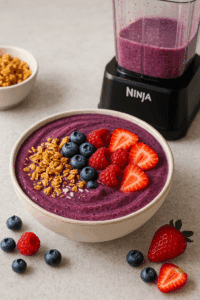
Frozen berry smoothie bowls are not just thicker smoothies. They are low-liquid vortex control tests.
Mixed berries introduce skin resistance. Banana compresses under blade pressure. Greek yogurt increases density. When liquid is limited, circulation becomes geometry-dependent.
In the Ninja BN751, the Smoothie Auto-iQ cycle alternates pulse bursts and sustained high RPM to prevent stall pockets while preserving thickness. This is not accidental. It is motor behavior tuned for frozen load management.
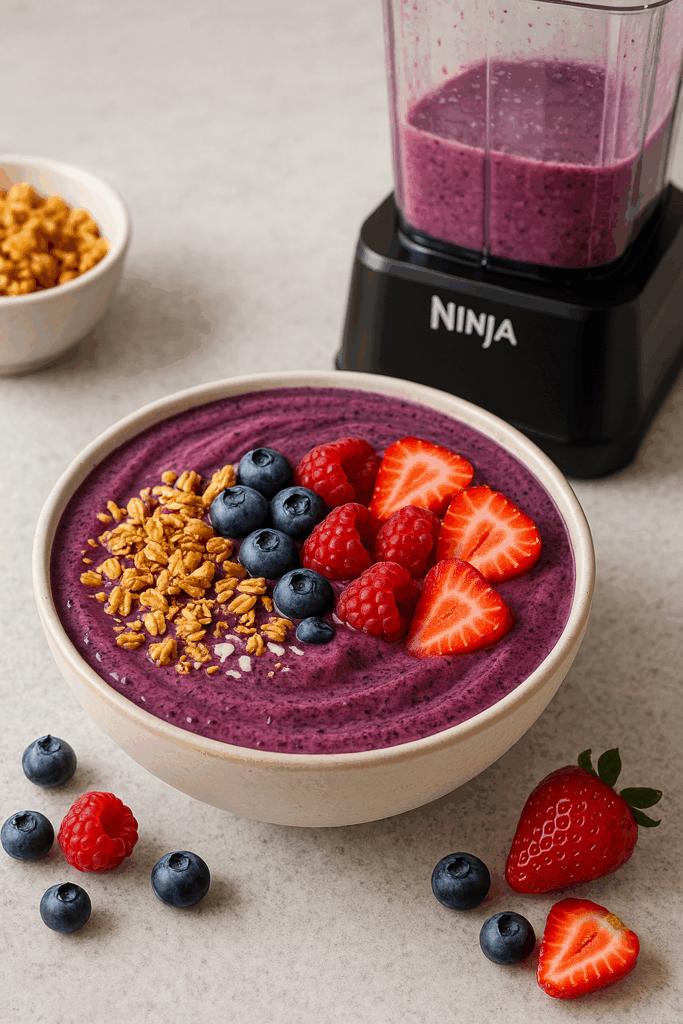
When built correctly, the bowl becomes spoonable, stable, and evenly textured without turning into a drink.
Performance Framing: Frozen Fruit Vortex Control
Berries behave differently from mangos or pineapples. Blueberry skins resist rupture longer. Raspberries contain micro-seeds that demand prolonged shear exposure.
The BN751’s 1,400-watt motor creates enough sustained RPM to maintain central vortex formation even under restricted liquid conditions. Lower-powered systems lose circulation when density increases.
If you’re comparing how various high-speed countertop systems maintain vortex integrity under frozen load pressure, our layered motor durability breakdown across blending categories maps out exactly where weaker designs fail.
This bowl recipe sits in the high-density frozen classification tier.
Table of Contents
Ingredients (Serves 2)
1 frozen banana
1 cup frozen mixed berries
¼ cup frozen mango or pineapple
½ cup plain Greek yogurt (or coconut yogurt)
½ cup almond milk (start with less for thickness)
1 tablespoon chia seeds (optional)
½ teaspoon vanilla extract
Optional toppings:
Fresh berries
Granola
Nut butter drizzle
Hemp seeds
Shredded coconut

Step-by-Step Instructions (With Circulation Cues)
- Add almond milk first to create blade lubrication.
- Add yogurt to establish base density.
- Add frozen fruit last.
Secure the lid and select Smoothie Auto-iQ.
Watch for these stages:
• Initial fracture pulses
• Partial circulation collapse
• Full vortex stabilization
If the mixture stalls, stop and redistribute frozen fruit toward the center.
Blend only until thick and uniform. Over-blending introduces unwanted air.
Why This Model Maintains Thickness Without Stalling
Smoothie bowls challenge circulation geometry. Too little liquid collapses the flow. Too much liquid thins the texture.
The BN751 handles this balance because of blade reach and timed pulse staging. The system clears dense fruit from outer walls before sustained speed ramps up.
We documented its frozen-fruit load behavior, seed breakdown efficiency, and sustained torque consistency in our controlled lab-style performance audit of the BN751’s blending system.
Understanding how this motor behaves under restricted liquid conditions allows you to adjust confidently.
Texture Engineering: How to Achieve Spoonable Density
Thickness depends on three variables:
• Frozen mass ratio
• Yogurt fat content
• Liquid starting volume
Start with ¼ cup almond milk instead of ½ if you want extreme thickness.
If the mixture is too loose:
Add frozen banana pieces.
If the mixture is too dense:
Add liquid one tablespoon at a time.
Avoid adding ice unless absolutely necessary. Ice fractures differently and creates a granular texture rather than a creamy density.
Why Do Smoothie Bowls Turn Into Regular Smoothies
This happens when:
• Liquid exceeds blade height too early
• Frozen fruit volume is insufficient
• Blend cycle runs longer than required
The Smoothie preset is optimized for drinkable blends. To maintain bowl consistency, monitor visually and stop once the texture becomes uniform.
Early stopping preserves density.
Do Berry Seeds Fully Break Down?
Raspberry and strawberry seeds require extended shear exposure.
The BN751 reduces seed texture significantly but will not eliminate micro-seed presence entirely. However, proper blending removes grittiness.
If seed texture remains noticeable, redistribute contents and run a short secondary pulse cycle rather than a full restart.
Seed refinement improves with central blade engagement.
Can Thick Bowls Overheat the Motor?
Dense blends generate higher resistance than thin smoothies.
The BN751 tolerates this well, but:
• Avoid repeated back-to-back thick cycles
• Allow cooling between large batches
• Stay below max fill line
Most overheating concerns arise from exceeding capacity, not density alone.
How Antioxidant Oxidation Changes Texture
Berry blends oxidize when exposed to air.
Signs of oxidation:
• Slight color dulling
• Thin liquid separation
• Surface darkening
To reduce oxidation:
• Consume immediately
• Minimize headspace
• Avoid prolonged post-blend exposure
This preserves color and nutrient stability.
Storage and Scaling Strategy
For meal prep:
• Pre-portion frozen fruit into bags
• Store yogurt separately
• Blend fresh with minimal liquid
To double batch:
Use a 72-oz pitcher.
Increase frozen mass first, then liquid incrementally.
Large pitcher geometry changes vortex formation slightly, so blend time may increase.
If you are building a weekly rotation of high-density bowls, protein blends, and recovery-focused smoothies, our evolving performance-tiered blender recipe archive organizes recipes by texture resistance, fiber load, and liquid ratios so you can match blends to motor behavior instead of guessing.
Owner Clarifications About Thick Berry Blends
Can I prep smoothie bowl freezer packs?
Yes. Freeze fruit together. Add yogurt and liquid only when ready to blend.
Is the BN751 strong enough for limited-liquid bowls?
Yes. Its torque output handles dense frozen fruit loads without stalling when layered properly.
Why does my bowl sometimes look grainy?
Insufficient pulse staging or uneven fruit distribution. Stir and re-pulse briefly.
Can I make this fully dairy-free?
Yes. Replace yogurt with coconut yogurt or frozen avocado for creaminess.
Is this suitable for post-workout?
Yes. It provides carbs, fiber, and moderate protein. Add protein powder for recovery focus.
Skill Building: Reading Vortex Behavior
Smoothie bowls teach vortex recognition.
If the mixture climbs the wall and stops circulating, the liquid is insufficient.
If the vortex forms instantly and deeply, liquid is excessive.
Mastering this visual cue allows you to adjust density mid-cycle rather than guessing.
Contrast in Texture Profiles
If you want to evaluate how the BN751 handles fiber-heavy green blends compared to high-density frozen bowls, prepare the citrus-forward green extraction protocol we used for immune-boost testing.
Comparing these two recipes highlights how fiber suspension differs from frozen-density circulation.
Final Takeaway
The Frozen Berry Energy Smoothie Bowl is not just antioxidant-rich. It is a vortex management exercise for the Ninja BN751.
Control liquid. Watch circulation. Stop early.
When you understand frozen load geometry, thick bowls become repeatable instead of unpredictable.