Smoothie bowls require power control.
Too much speed creates soup.
Too little torque leaves frozen chunks.
The KitchenAid K400 excels at controlled vortex blending. Its asymmetric blade and ribbed jar design pull dense frozen fruit downward without needing a tamper.
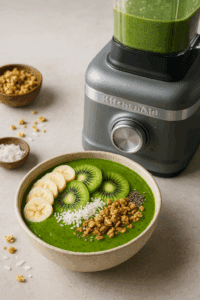
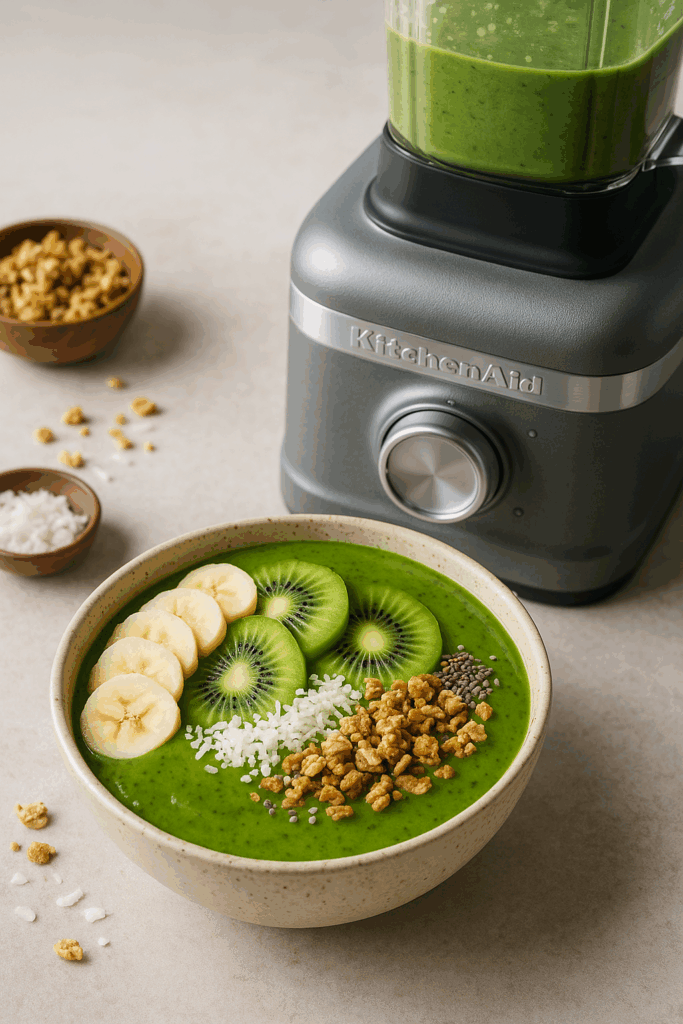
This tropical green smoothie bowl combines mango, pineapple, banana, and spinach into a thick, spoonable base that holds toppings without sinking.
If you’re still evaluating blender strength before committing to a countertop model, this in-depth comparison of premium blender motor performance across major brands explains how torque control impacts frozen blends and thick mixtures.
This recipe is structured for thickness, not drinkability.
Table of Contents
Ingredients (Serves 2)
- ½ frozen banana
- ½ cup frozen mango chunks
- ½ cup frozen pineapple chunks
- 1 cup baby spinach
- ¼ cup coconut milk
- ¼ cup plain Greek yogurt (or plant-based)
- 1 tablespoon chia seeds
- Optional: ½ teaspoon lime juice
Toppings: sliced banana, kiwi, shredded coconut, granola, chia seeds, hemp seeds
Frozen fruit provides structure. Avoid fresh mango for bowl texture.
Step-by-Step Instructions
- Add coconut milk and yogurt to the jar first.
- Layer frozen banana, mango, and pineapple next.
- Add spinach and chia seeds on top.
- Secure the lid tightly.
- Use the Smoothie preset.
- Blend 45–60 seconds until thick and smooth.
- Stop and scrape sides if necessary.
- Spoon into bowls immediately.
Do not overblend. Excess blending reduces structure.
If you want more appliance-matched breakfast blends organized by texture category, this structured smoothie and bowl recipe library, categorized by blending system, helps match consistency goals with the right machine.
Texture & Technique: How the K400 Builds a Thick Vortex Without a Tamper
Smoothie bowls fail when vortex collapse occurs.
Vortex collapse happens when frozen fruit rotates above the blade instead of feeding into it.
The KitchenAid K400 prevents this through:
- Asymmetric stainless steel blade
- Ribbed jar walls
- Controlled speed ramp
These elements pull ingredients downward consistently.
The Smoothie preset gradually increases blade speed. That crushes frozen fruit before it liquifies too quickly.
For a detailed breakdown of jar geometry and preset ramp performance under thick loads, review the real-world blending evaluation of the KitchenAid K400 under frozen stress testing.
Understanding jar dynamics helps prevent watery bowls.
Tips & Variations
Thicker base:
Reduce the coconut milk slightly.
Higher protein:
Add ½ scoop vanilla protein powder.
More fiber:
Blend in ¼ avocado.
Lower sugar option:
Replace pineapple with zucchini chunks.
Different greens:
Use kale, but remove stems first.
Small adjustments impact final density. Blend conservatively.
Nutrition Snapshot (Per Serving Approximation)
- 300 calories
- 7g protein
- 8g fiber
- High vitamin C
- Potassium support
- Iron from spinach
- Vegetarian
- Gluten-free
This works as:
- Breakfast
- Post-workout refuel
- Light lunch
- High-fiber energy bowl
Why Does My Smoothie Bowl Turn Runny?
Excess liquid causes a thin texture.
For bowls, the total liquid should stay under ½ cup.
If the mixture becomes runny:
- Add frozen mango
- Blend briefly
- Avoid extended high-speed cycles
The K400 processes frozen fruit quickly. Overblending reduces structure.
Can You Use Fresh Fruit Instead of Frozen?
Fresh fruit increases water release.
Water release weakens the thickness.
If using fresh mango or pineapple:
- Add ½ cup of ice
- Reduce the liquid slightly
- Blend shorter duration
Frozen fruit remains the best option for structural integrity.
What Happens If You Don’t Use Enough Liquid?
Insufficient liquid prevents vortex formation.
The blade spins without pulling ingredients downward.
If this happens:
- Add 1 tablespoon of liquid
- Restart blend
- Allow the preset ramp to continue
Avoid forcing thick blends without enough base liquid.
Practical Questions Before You Blend
Can the KitchenAid K400 handle frozen fruit without a tamper?
Yes. The blade design and jar shape pull dense ingredients into circulation automatically.
Is this smoothie bowl sweet enough without added sugar?
Yes. Ripe bananas and pineapple provide natural sweetness. Add a date if desired.
Can you prep smoothie bowls in advance?
You can prep ingredients. Blend just before serving for the best texture.
Can you make this dairy-free?
Yes. Use plant-based yogurt.
How thick should a smoothie bowl be?
It should hold toppings without sinking immediately. Spoon texture should remain firm.
If you prefer warm, spoonable blends instead of cold bowls, this butternut squash soup blending method is optimized for the KitchenAid K400 jar geometry, which demonstrates how the same vortex system performs with dense cooked vegetables.
Is It Better to Use the Smoothie Preset or Manual Speed Control for Smoothie Bowls?
For thick smoothie bowls, presets are usually more reliable.
The KitchenAid K400 Smoothie preset gradually increases blade speed. That staged ramp prevents frozen fruit from splashing upward before vortex formation stabilizes.
Manual blending works, but it requires attention.
If blending manually:
- Start on low speed.
- Increase gradually over 10–15 seconds.
- Stop once the mixture becomes thick and uniform.
Avoid jumping straight to maximum speed. High-speed shock liquifies frozen fruit too quickly and reduces the bowl structure.
Preset mode improves consistency for repeat batches.
How Do You Make a Smoothie Bowl Thicker Without Adding More Fruit?
Adding more frozen fruit increases sweetness and calories.
To thicken without changing flavor balance:
- Reduce the liquid by one tablespoon.
- Add ½ tablespoon chia seeds.
- Add ¼ avocado for fat-based density.
- Blend slightly shorter.
The KitchenAid K400 processes small thickening additions easily because the jar ribs maintain downward circulation.
Thickness control depends more on the liquid ratio than the ingredient quantity.
Small adjustments make a noticeable difference.
Why Does Spinach Sometimes Leave Green Specks in Smoothie Bowls?
Green specks appear when leafy greens fail to fully circulate.
This usually happens when:
- Greens are placed directly against the jar wall.
- The blend stops too early.
- Frozen fruit blocks circulation.
To prevent this:
- Add liquid first.
- Place greens above frozen fruit.
- Allow the preset to complete fully.
The K400’s asymmetric blade pulls ingredients downward efficiently, but layering still matters.
If specks remain, blend for an additional 5–10 seconds only.
Do not overblend. Texture can thin quickly once frozen fruit breaks down.
Can the KitchenAid K400 Handle Daily Smoothie Bowl Prep?
Yes.
The K400 motor is built for repeated frozen blending cycles.
Its metal drive coupling and sturdy jar construction reduce long-term wear from dense loads.
For daily use:
- Rinse immediately after blending.
- Avoid dried residue buildup.
- Do not overload beyond the maximum fill line.
Batch prep works well with countertop systems like the K400. The jar capacity supports multiple servings without strain.
Storage & Real-World Use
Smoothie bowls are best fresh.
Refrigeration thins the texture.
If storing:
- Seal tightly
- Refrigerate for under 12 hours
- Stir before serving
Ideal use cases:
- Weekend breakfast
- Post-workout fuel
- High-fiber morning reset
- Meal prep topping bar
Countertop blenders like the K400 excel in batch prep scenarios.
Final Takeaway
This tropical green smoothie bowl is engineered for the KitchenAid K400’s vortex system.
Use frozen fruit. Control liquid. Avoid overblending.
The asymmetric blade and ribbed jar create a thick, spoonable texture without a tamper.
When structure matters, controlled torque wins.