Cashew cream exposes weak emulsification fast. If blade speed fluctuates or circulation breaks, you get grit, paste pockets, or uneven herb streaking. Thick nut sauces are not smoothie territory. They are torque retention and micro-particle refinement tests.
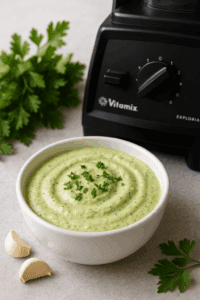
This Garlic Herb Cashew Cream Sauce is engineered specifically for the Vitamix E310. It demonstrates how a compact 48-ounce container and manual speed control create restaurant-level smoothness from dense, soaked nuts without overheating or stalling.
If you are comparing how different machines handle thick nut bases, heavy dips, and high-fat blends, review the structured sauce and nut butter stress results inside the appliance comparison framework built around real torque and resistance trials.
This recipe is not about being dairy-free. It is about understanding how your blender manages density.
Performance Framing: Why This Works in the Vitamix E310
Cashews contain high fat and moderate protein. When blended with minimal liquid, they form a paste before becoming cream. Many blenders stall during this transition stage.
This sauce intentionally uses:
- Minimal water
- High nut concentration
- Raw garlic for structure
- Fresh herbs added late to test finishing integration
The Vitamix E310 excels because its narrow container keeps the thick mass cycling back into the blade path instead of spreading thin across a wide base.
If you want more blends organized by what they teach about circulation physics, heat control, and emulsification behavior, explore the blender recipe index designed around performance categories rather than meal types.
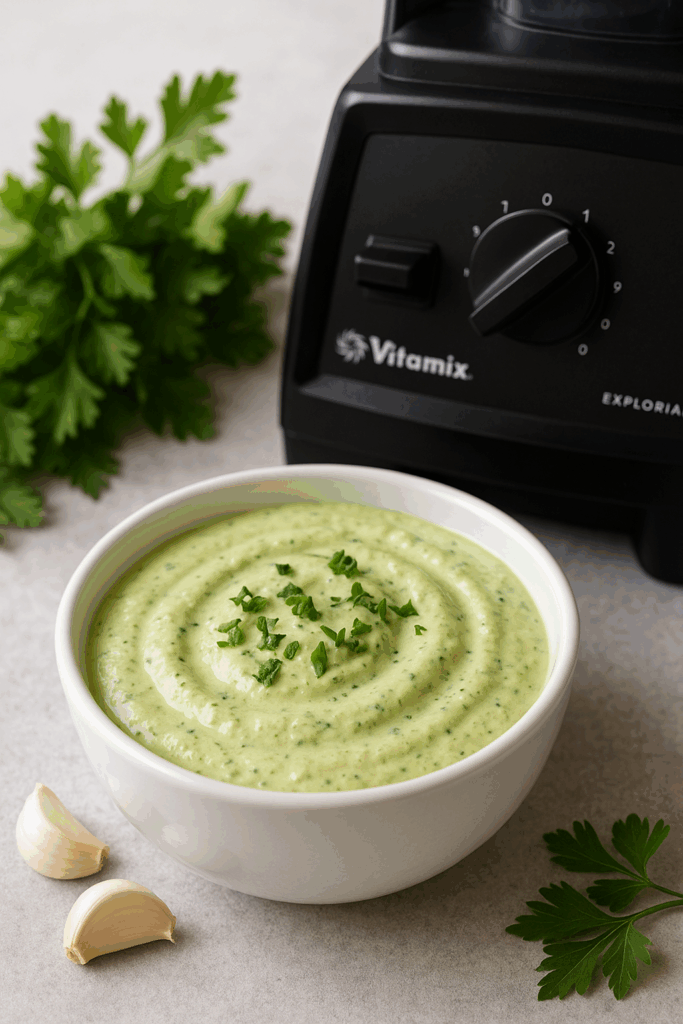
Table of Contents
Ingredients (Yields About 1½ Cups)
- 1 cup raw cashews, soakedfor 4 hours or boiled 10 minutes
- ¾ cup filtered water
- 2 tablespoons fresh lemon juice
- 2 cloves garlic, peeled
- 1 tablespoon olive oil
- ½ teaspoon sea salt
- ½ cup loosely packed parsley or cilantro
- 1 tablespoon chopped chives, optional
- Fresh ground pepper

Step-by-Step Instructions With Blending Cues
1 Soften the Cashews for Controlled Breakdown
Soak cashews in water for 4 hours. For faster prep, boil for 10 minutes. Drain and rinse thoroughly.
Hydration reduces blade shock and shortens paste phase time.
Blending cue: properly soaked cashews transition from grainy to creamy in under 90 seconds.
2 Load the E310 for Emulsion Stability
Add soaked cashews, water, lemon juice, garlic, olive oil, and salt first. Leave herbs out initially.
Correct loading prevents uneven dispersion and allows the fat and water to begin binding smoothly.
3 Build Speed Gradually to Prevent Paste Lock
Start at speed 1. Increase slowly to speed 10 over 15 seconds.
Blend 60 to 90 seconds. Use the tamper lightly when circulation slows. The mixture will first resemble a thick paste, then loosen into cream as particle size decreases.
Blending cue: when the sound changes from heavy churning to smooth hum, emulsion has formed.
4 Add Herbs Without Overprocessing
Reduce speed to 3 or 4. Add parsley and chives. Blend 10 to 15 seconds until evenly distributed.
Overblending herbs can dull flavor and darken color.
Why It Works Specifically in the Vitamix E310
The E310 maintains torque when the mixture thickens mid-blend. That moment is critical. Many blenders lose speed as resistance increases, creating uneven texture.
Its hardened blades and compact jar geometry keep the cashew mass moving through the blade zone consistently.
For a full breakdown of how this model performs across sauces, soups, and dense smoothie loads, study the in depth Vitamix E310 evaluation that documents torque retention under heavy ingredient stress.
If you want to test how the same motor handles a warm, vegetable-forward blend that transitions from chunked produce to silky soup, make the Vitamix E310 roasted red pepper soup that demonstrates high-heat puree consistency next.
Texture Control and Emulsification Technique
Understanding the Paste Phase
When blending thick nut bases, you enter a paste phase where particles are partially broken down but not yet suspended evenly. This stage feels dense and resistant.
Do not add excess water immediately. Maintain speed and allow blade friction to reduce particle size further.
Adjusting Thickness Without Breaking Emulsion
If too thick, add 1 tablespoon of water at a time while blending at medium speed. Adding too much liquid at once can thin the sauce unevenly and weaken its structure.
Oil Integration Timing
Olive oil helps create a smoother mouthfeel. Adding it early supports emulsification. Skipping oil produces a slightly grainier but lighter sauce.
Why Is My Cashew Cream Still Gritty
Grittiness usually means cashews were under-soaked or blending stopped during the paste phase. The E310 requires enough time at high speed to reduce particles fully.
Ensure proper soaking and allow a full 60 to 90 seconds of blending at high speed.
How to Prevent Overheating During Thick Blends
Thick sauces generate friction heat. If you blend longer than needed, the temperature can rise and slightly alter the flavor.
Limit high-speed blending to under two minutes. If making a double batch, allow a short pause between cycles.
Can I Make This Nut Free
Yes. Sunflower seeds can replace cashews. However, they require slightly longer blending to achieve comparable smoothness.
Expect a darker color and slightly earthier flavor.
What Happens If I Skip the Oil
Skipping oil reduces fat content and slightly changes mouthfeel. The sauce may feel less silky but still smooth if blended properly.
The E310’s blade efficiency compensates for lower fat emulsification support.
Storage Scaling and Practical Use
Storage
Refrigerate in an airtight jar for up to 6 days. Stir before serving, as natural separation can occur.
Freezing
Freeze in small silicone molds for up to one month. Thaw in the refrigerator and stir to restore consistency.
Scaling
The E310 can handle double batches. Blend slightly longer and monitor heat buildup during thick cycles.
Performance and Texture Questions Vitamix E310 Owners Actually Ask
Can I skip soaking the cashews?
You can boil them instead, which softens them quickly. Skipping softening entirely often leaves graininess because the blades must work much harder to break down dry nuts.
Is this sauce better cold or warm?
It works both ways. Cold, it functions as a dip or spread. Warmed gently, it coats pasta or roasted vegetables smoothly without separating.
Can I use dried herbs instead of fresh?
Yes, but use smaller amounts because dried herbs are concentrated. Fresh herbs blend more evenly and provide better color and aroma.
How thick should the sauce be?
It should be spoonable and hold its shape briefly before settling. If too thick, add water one tablespoon at a time while blending.
Can I double the recipe safely?
Yes. The E310 maintains torque well in thicker loads, but you may need slightly longer blending to achieve uniform smoothness.
Final Takeaway
This Garlic Herb Cashew Cream Sauce is not just a dairy-free alternative. It is a controlled emulsification exercise that reveals how the Vitamix E310 handles dense, high-fat blends.
You learn to recognize the paste phase, manage torque under resistance, and adjust thickness without sacrificing smoothness. Once you master this sauce, thick hummus, nut butters, and creamy soups become predictable instead of frustrating.
That is appliance confidence built through performance understanding.