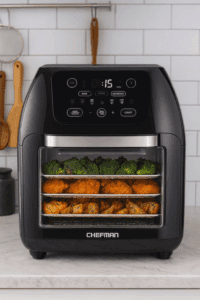
The CHEFMAN Multifunctional Digital Air Fryer+ Rotisserie looks like the answer for anyone who wants one appliance that can air fry, bake, roast, dehydrate, and handle rotisserie chicken without turning on a full oven.
But here is the real question.
Does it actually improve weeknight cooking, or does it become a bulky appliance you stop using after the first month?
This review answers that directly, using real dinner workflow, ownership realities, and regret scenarios.
If you want to see how this style compares to basket models, dual-basket systems, and other air fryer ovens, start with this hands-on air fryer review library that explains what each style does best.
Verdict
The CHEFMAN Multifunctional Digital Air Fryer+ Rotisserie is worth buying if you want an oven-style air fryer that can cook full meals, handle rotisserie chicken, and reduce oven use on busy nights. It is not the best pick if you have limited counter space, hate fan noise, or expect perfect, even browning when the racks are overloaded.
Its biggest strength is meal flexibility with real capacity.
Its biggest drawback is footprint, plus the extra cleaning that comes with oven-style designs.
If you cook dinner most nights, it makes sense.
If you mainly cook snacks, it may feel like too many appliances.
Table of Contents
What Makes the CHEFMAN Multifunctional Different From Standard Air Fryers
Most air fryers are drawer and basket machines. They excel at crisping small batches fast.
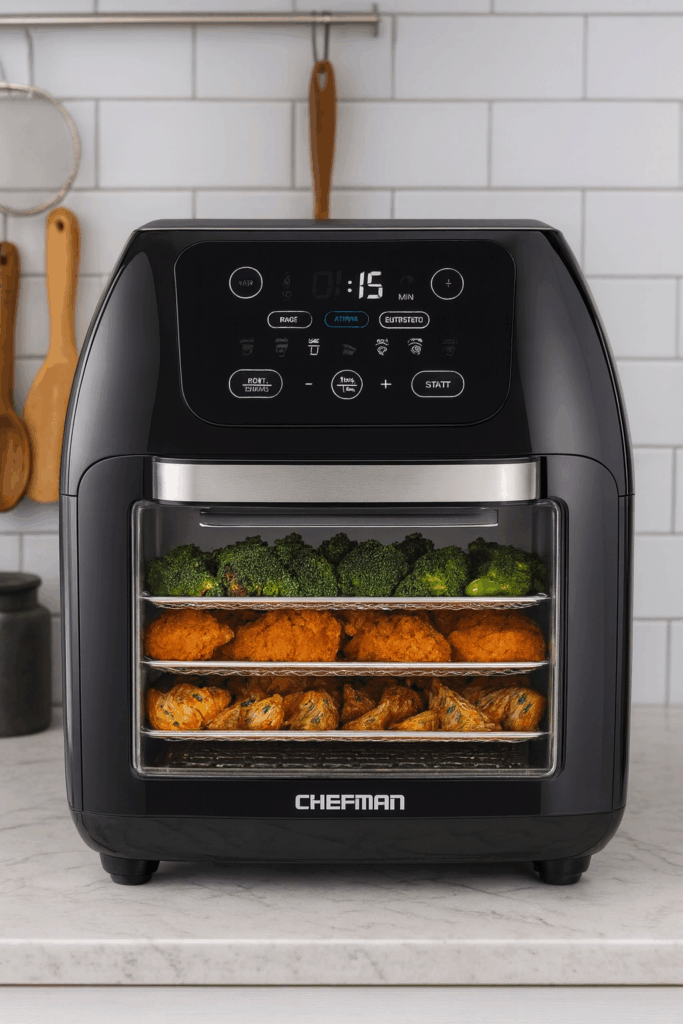
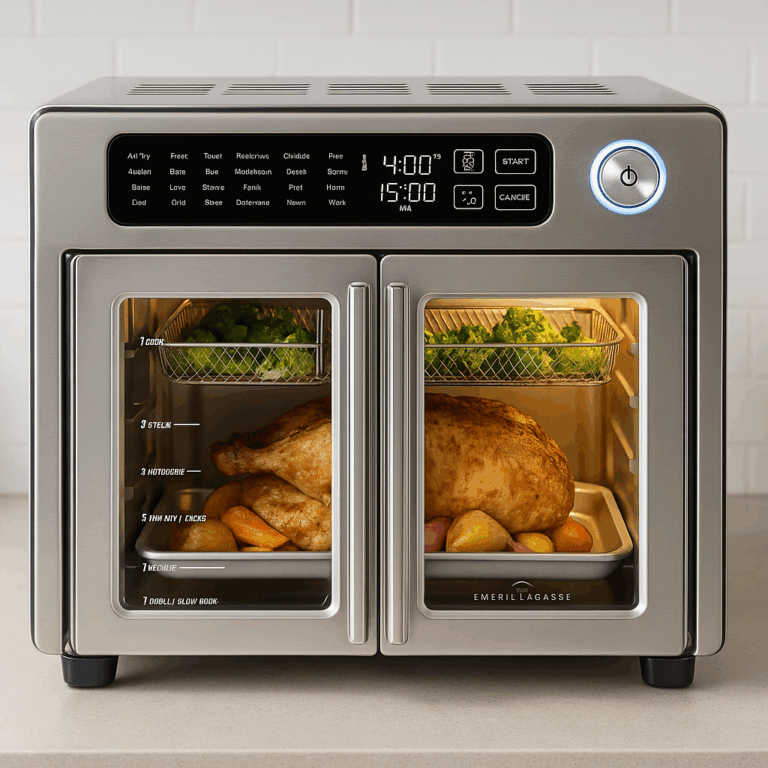
This CHEFMAN is a countertop air fryer oven.
That changes the experience.
Instead of one basket, you get:
- A front-opening door
- Multiple airflow racks
- A drip tray
- A rotisserie spit and retrieval tool
- A big viewing window with interior light
It also leans into presets. You get many cooking modes, including air fry, bake, roast, dehydrate, and rotisserie.
The practical difference is simple.
You can cook like you would in an oven, but faster. You also get airflow crisping that ovens often fail at.
Best for: People who want oven-style cooking with less preheat time and less kitchen heat.
How the Multi-Function System Works in Daily Use
This unit lives or dies on workflow.
With basket air fryers, you load food, set time, and shake.
With oven-style air fryers, you think in racks and spacing.
Presets and Touchscreen Controls
The touchscreen is straightforward. The presets reduce decision fatigue. That matters on weeknights.
You can still set the time and temperature manually. That is where you get the best results.
Multi Rack Cooking
Multi-rack cooking is the biggest advantage and the biggest trap.
It is an advantage because you can cook:
- Protein on one rack
- Vegetables on another
- Bread or sides on the third
It is a trap because airflow needs space.
If you stack food tightly on all racks, the results get uneven. Browning becomes inconsistent.
You do not need perfection. You do need a habit.
Rotate racks once for bigger meals. Shake vegetables at least once.
The tradeoff: Real meal capacity versus hands-off simplicity.
Decision cue: If you like oven cooking, you will adapt fast. If you want set-it-and-forget-it, you may feel friction.
Rotisserie Function: Useful Upgrade or Occasional Feature
Rotisserie is the headline feature. For many people, it is also the reason to buy this model.
Here is the honest take.
Rotisserie is worth it if:
- You cook a whole chicken at least twice a month
- You prefer a self-basting meat texture
- You want crispy skin without babysitting
Rotisserie is not worth it if:
- You only cook chicken breast
- You do not want to clean the grease splatter
- You rarely cook large cuts of meat
In real use, a rotisserie is a weekend feature for many households. It becomes a routine feature for families that rely on chicken as a staple protein.
Reality check: The rotisserie benefit is real, but it is not magical. The chicken still needs seasoning, trussing, and space.
Cooking Performance: Is Crisping Consistent Across Racks
Air fry performance depends on airflow path and spacing.
Basket air fryers have tighter airflow. They often crisp faster.
Oven-style air fryers give you more space and more flexibility. They can crisp well, but they punish overcrowding.
Where This Unit Performs Best
You get strong results with:
- Frozen fries and nuggets
- Wings and drumsticks
- Reheating pizza and leftovers
- Roasted vegetables, if spaced well
- Toasted bread and melts
Where It Needs Attention
You need more active management with:
- Thick cuts of meat on multiple racks
- Dense vegetables piled high
- Anything breaded on two racks at once
If you use only one rack, crisping is easier. If you use two racks, rotate once. If you use three racks, accept some tradeoffs.
The tradeoff: Better meal coverage, but less “perfect crisp” consistency at max load.
Capacity Reality: What 10 Liters Means for Real Meals
A 10-liter cavity is a real advantage.
It means:
- You can cook for a family without two batches
- You can fit a small whole chicken
- You can spread food thinner than most baskets allow
It also means the unit is not small.
On most counters, it occupies microwave-level presence.
If you plan to store it, you should not. This is a leave-it-out appliance.
Best for: Families of 3 to 5, and meal preppers.
Watch out for: Apartment kitchens with limited counter depth.
What Cooking a Real Dinner Looks Like With the CHEFMAN
Here is a dinner that reflects real life.
Dinner Test: Chicken Thighs, Sweet Potatoes, and Broccoli
Goal: One appliance, one dinner rhythm, minimal stress.
Set up:
- Rack 1: Bone-in chicken thighs
- Rack 2: Sweet potato wedges
- Rack 3: Broccoli florets (added later)
Cook plan:
- Chicken: 390 to 400°F range
- Potatoes: Similar heat, but needs more time
- Broccoli: Goes in for the last 8 to 10 minutes
Timing Comparison vs Oven
Traditional oven:
- Preheat: 10 to 15 minutes
- Cook: 35 to 45 minutes
- Total: 50 to 60 minutes, plus tray handling
CHEFMAN:
- Preheat: Not required, but warm-up is fast
- Cook: About 30 to 40 minutes total
- Total: About 35 to 45 minutes, depending on thickness
The win is not just speed. It is rhythm.
You avoid the preheat stall. You avoid heating the kitchen. You check through the window instead of opening a full oven door.
Preheat Reality
Many owners skip preheat. That works for most foods.
If you want better browning on breaded foods, preheating helps. If you want better skin crisp on chicken, preheating helps.
Reality check: No preheat is convenient. A short preheat is often better.
Noise Reality During Dinner
The fan is noticeable. It is steady. It is not harsh.
In an open kitchen, it becomes background sound. In a quiet apartment, you will hear it clearly.
If you care about noise, plan to run it earlier in the evening.
Counter Space Impact During Prep
This unit changes how you prep.
You will stage trays and racks near it. You will want space to slide racks out safely.
If your counter is tight, the workflow feels cramped.
Decision cue: This is a great dinner tool if your kitchen layout supports it.
Where the CHEFMAN Frustrates Owners
Most frustration comes from expectations.
Counter Footprint and Clearance Needs
This unit is bulky. It needs ventilation space around it.
If you expected to tuck it into a corner, you may fight it.
Tradeoff: Real capacity versus counter comfort.
Uneven Browning When Loaded Heavy
When racks are crowded, airflow suffers.
You can fix most of it with:
- Better spacing
- A mid-cook rack swap
- A quick shake of vegetables
But you have to do it.
Tradeoff: Multi-rack cooking versus “perfect even” hands-off results.
Fan Noise at Higher Heat
Higher temperatures create more audible airflow.
It is normal. It is also real.
If you are noise sensitive, this can be a daily annoyance.
Tradeoff: Strong convection airflow versus quiet kitchens.
No Dedicated Preheat Button
Some people like a clear preheat function. This unit does not make preheating a big ritual.
You can still preheat manually. It just takes awareness.
Tradeoff: Simpler interface feel versus dedicated precision steps.
Why Some Buyers Regret Choosing the CHEFMAN
Regret usually shows up in a few predictable situations.
Small Kitchen Mismatch
If counter space is limited, this unit can dominate daily life.
It is not just width. It is the door swing and rack handling.
Rotisserie Looks Cool, Then Never Gets Used
If you buy it for a rotisserie but do not cook whole birds, you may feel like you overpaid for a feature you do not use.
Expecting Basket Level Crisp on Everything
Oven-style air fryers can crisp well. But they do not always match a tight basket’s intensity.
If your main goal is fries and wings only, a basket model may feel better.
Bottom line: Most regret comes from buying this for an ideal routine, not your real routine.
After 30 to 60 Days of Use: What Changes
This is where the truth shows up.
What Becomes Easy
- Weeknight chicken and vegetables
- Reheating leftovers without sogginess
- Cooking frozen food without planning
- Toasting and quick bakes
What Becomes Annoying
- Grease film on interior surfaces
- Racks that need quick scrubbing
- Drip tray cleanups after fatty cooks
Does It Replace Oven Use
For many homes, yes, for weeknights.
You still use the oven for:
- Big sheet pans
- Large baking projects
- Holiday volume cooking
Long-Term Wear Starts to Show Where
The first signs of wear usually involve:
- Staining on the drip tray
- Slight darkening inside the cavity
- Minor scuffs on racks from frequent use
None of this is failure. It is normal appliance aging.
Bottom line: Satisfaction stays high if you clean lightly and often. Satisfaction drops if you let grease build.
How Durable Is the CHEFMAN Long Term
Durability is hard to judge in one meal. Ownership pattern matters.
Door, Hinge, and Seal
The door experience matters because you use it constantly.
A sturdy hinge keeps the unit feeling premium. A loose hinge makes it feel cheap fast.
This model generally feels stable, but oven-style units have more moving parts than baskets.
Heating and Airflow
Airflow performance depends on cleanliness.
Grease buildup near the fan area can impact heat circulation. That can create uneven results over time.
This is why maintenance matters more here than it does in a simple basket.
Touchscreen Longevity
Touch panels can last for years. They also hate grease and moisture.
Wipe the panel often. Keep it dry.
Long-term expectation: Solid value, but it rewards consistent care.
Cleaning and Long-Term Maintenance
Cleaning is the hidden cost of oven-style air fryers.
What Is Easy
- Racks are removable
- Drip tray catches most mess
- Many parts can go in the dishwasher
What Needs Habit
Interior walls collect splatter, especially after rotisserie.
A quick wipe after fatty cooks prevents buildup. If you wait a month, the cleanup becomes a project.
If you want a simple system for keeping air fryers fresh, odor-free, and consistent, use this practical best-air-fryer guide section that explains what ownership is like across designs before you commit to a style.
Watch out for: Skipping cleanup after bacon, wings, or rotisserie chicken.
Best for: People who do small cleanups often.
Does the CHEFMAN Replace an Air Fryer, Toaster Oven, or Oven
This is the replacement question buyers actually care about.
Replace a Standard Basket Air Fryer
For full meals, yes.
For maximum crisp snacks, not always.
If you cook:
- Full dinners
- Multi-component meals
- Rotisserie chicken
This feels like an upgrade.
If you cook:
- Fries
- Nuggets
- Wings only
A basket air fryer may be simpler and crispier.
Replace a Toaster Oven
Often, yes.
It can toast, bake small items, and reheat better than many toaster ovens because airflow helps.
Replace a Full Oven
For weeknights, partly.
For baking precision and big volume, no.
Bottom line: It can replace a toaster oven and reduce oven use heavily. It does not fully replace a full-size oven.
Comparing the CHEFMAN to Other Air Fryer Styles
This section is about decision clarity, not brand combat.
Versus Basket Air Fryers
- More capacity
- Better meal flexibility
- Slightly less intense crisping at max load
- More cleaning surfaces
The tradeoff: Meal coverage versus snack simplicity.
Versus Dual Basket Air Fryers
- One large cavity instead of two zones
- Rotisserie capability
- Less “sync finish” style workflow
- Better for whole birds and taller foods
The tradeoff: Rotisserie and rack cooking versus two-zone timing control.
Versus Countertop Convection Ovens
- Faster heat-up
- Better crisping for frozen foods
- Often lower energy for small meals
- Smaller cavity than many true countertop ovens
Decision cue: Choose this if you want air fryer crisp plus oven-style flexibility in one unit.
Who This Air Fryer Is For
Best for:
- Families cook dinner most nights
- Meal preppers who cook proteins and vegetables together
- People who want rotisserie at home
- Anyone trying to use the oven less in summer
- Homes that like “one appliance, many functions.”
If you care about flexible meals, this fits.
Who Should Avoid It
Avoid if:
- Your kitchen has limited counter space
- You want quiet appliances
- You cook mostly small snacks
- You hate cleaning interior walls
- You expect perfect, even browning when packed full
Reality check: This is a cooking workflow appliance. It rewards routine.
Common Questions Buyers Still Have
Can it cook frozen foods well?
Yes. Frozen fries, nuggets, and wings cook well. Spacing still matters.
Do I need to preheat it?
Not required for most foods. Preheating helps crisping and browning.
Is the rotisserie function hard to use?
It is simple after the first time. The retrieval tool helps a lot.
Is it loud?
It is moderately loud at higher heat. Fan noise is noticeable.
How hard is it to clean?
Racks and a drip tray are easy. Interior wipe-downs are the habit.
Is It More Efficient Than a Traditional Oven
For small to medium meals, yes.
A full oven heats a large cavity. That wastes energy when you cook one chicken tray.
This unit heats a smaller space fast. It also reduces preheat time.
Efficiency wins show up in three ways:
- Shorter total cook time
- Less preheat time
- Less ambient kitchen heat
Bottom line: It is more efficient for weeknight meals. It is not an oven replacement for large batches.
Final Takeaway
The CHEFMAN Multifunctional Digital Air Fryer+ Rotisserie is a strong pick for people who want one appliance that can handle dinner, not just snacks.
It saves time because it heats fast.
It saves effort because you can cook multiple components.
It earns its keep if you use a rotisserie even occasionally.
You will pay for that flexibility with counter space, fan noise, and more surfaces to clean.
Bottom line: Buy it if you cook real meals often and want oven-style versatility with air fryer crisp. Skip it if you mainly cook small snacks or cannot spare the counter space.