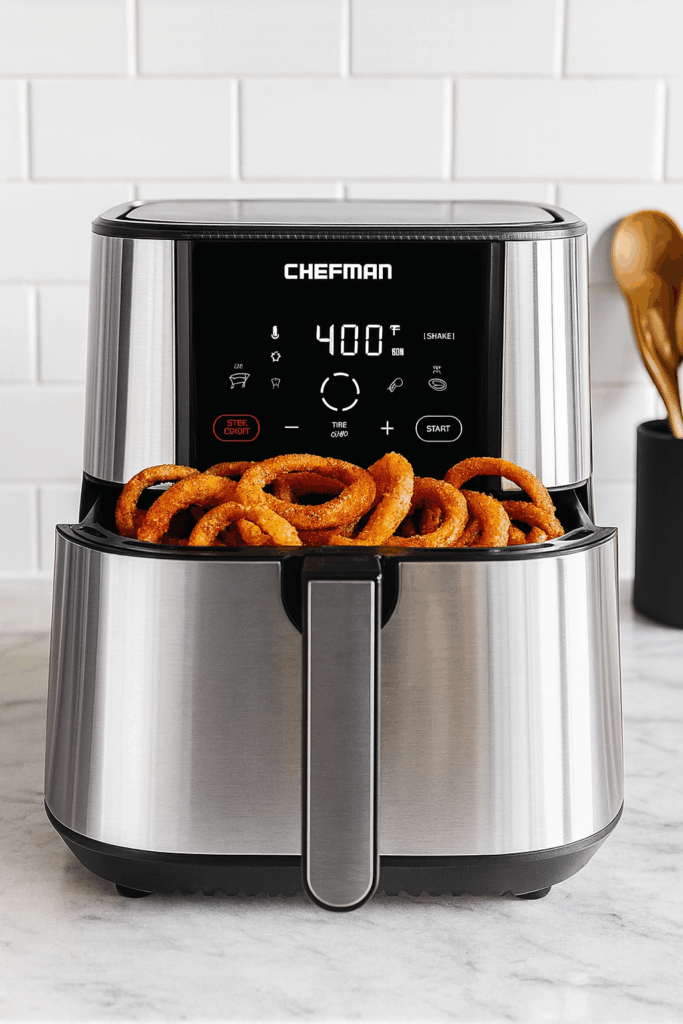
The Chefman TurboFry Touch 8QT is built for families who want large portions without complicated controls.
It promises crispy food, simple presets, and minimal guesswork.
But here is the real question.
Does the 8QT size actually improve your dinner routine, or does it just take up more counter space?
This review answers that through real cooking tests, long-term ownership patterns, and regret scenarios.
If you are comparing large-capacity basket models before choosing, start with this in-depth air fryer review hub that breaks down size differences and real-world performance.
Verdict
The Chefman TurboFry Touch 8QT is worth buying if you cook for four to six people regularly and want preset simplicity without managing multiple baskets or oven racks.
It performs well for batch cooking, frozen foods, and weeknight dinners.
It is not ideal for small kitchens or users who want advanced customization.
Its biggest strength is convenience at scale.
Its biggest drawback is counter footprint and moderate fan noise.
If you want fewer batches and simple controls, it makes sense.
If you cook small portions, it will feel oversized.
Table of Contents
What Makes the TurboFry Touch Different From Other 8QT Models
Many large air fryers focus on complexity.
Dual zones. Sync cooking. Rotisserie. Multi-rack interiors.
The TurboFry Touch takes a different approach.
It gives you:
- Large single-basket capacity
- One-touch digital presets
- LED shake reminder
- Straightforward temperature control
- Automatic shutoff safety
There is no learning curve.
Best for: Families who want capacity without managing multiple cooking zones.
8QT Capacity Reality: What It Actually Handles
An 8QT basket eliminates most batch cooking for mid-size families.
It comfortably fits:
- 3 to 4 chicken breasts
- 2 pounds of wings
- Vegetables for five people
- A full frozen bag of fries
- Large roasted potato batches
This reduces total dinner time by avoiding second rounds.
However, large baskets create a new discipline requirement.
If food is stacked too tightly, airflow weakens.
Even large air fryers still require spacing for optimal crisping.
The tradeoff: One-batch cooking versus airflow awareness.
Decision cue: If your current 5QT unit forces second cycles often, this upgrade feels immediately freeing.
What Cooking a Real Family Dinner Looks Like
Let’s test a realistic scenario.
Dinner Test: Chicken Thighs and Roasted Broccoli for Five
Setup:
Five bone-in chicken thighs spaced evenly
Broccoli florets around edges
Temperature:
400°F preset range
Traditional oven:
10 to 15 minutes preheat
30 to 35 minutes cook
Total: 40 to 50 minutes
Chefman TurboFry:
3-minute warm-up
22 to 28 minutes cook
Total: 25 to 30 minutes
You save roughly 15 to 20 minutes.
The LED shake reminder alerts midway. A quick shake improves browning.
The chicken skin crisps well when flipped once.
Noise is noticeable above 375°F but consistent.
Kitchen heat output remains significantly lower than oven use.
If you cook for five regularly, this workflow feels smoother than repeated smaller batches.
Presets and Shake Reminder: Gimmick or Helpful?
The TurboFry includes presets for common foods.
For beginners, this removes guesswork.
For experienced users, presets are starting points, not final settings.
The LED shake reminder is more useful than it sounds.
Many uneven cooking complaints in air fryers result from forgetting to shake.
The reminder creates better consistency without requiring constant monitoring.
Tradeoff: Automation improves consistency but still requires manual spacing.
If you prefer minimal thinking during dinner prep, these features genuinely help.
Where the TurboFry Frustrates Owners
Large capacity solves batch frustration but introduces size realities.
Counter Footprint
An 8QT basket requires dedicated counter space.
It is not something you will store daily.
Small kitchens may feel crowded.
Tradeoff: Family capacity versus countertop real estate.
Noise Level
At high heat, airflow is clearly audible.
Comparable to other large single-basket models.
Not disruptive, but not silent.
Limited Advanced Features
No dual baskets. No rotisserie. No dehydration.
It focuses on air frying only.
If you want advanced multifunction versatility, this may feel basic.
What It Struggles With
Even strong performers have limits.
The TurboFry struggles with:
- Cooking two distinct dishes with separate temperatures
- Wet batter foods
- Extremely thick steaks
- Large casseroles
It performs best when used for classic air fryer tasks:
- Wings
- Fries
- Roasted vegetables
- Reheating
The tradeoff: Strong everyday performance without specialty cooking modes.
Airflow and Crisping Depth Test: How Even Is It Really?
Large basket air fryers live or die on airflow consistency.
The TurboFry uses high-speed convection to circulate heat around a single large chamber.
In proper spacing conditions, results are strong.
Frozen fries crisp evenly with one shake.
Chicken wings brown well when flipped once.
Vegetables caramelize without sogginess.
Where inconsistency appears:
- When the basket is filled edge-to-edge
- When dense foods block lower airflow
- When food is stacked more than two layers deep
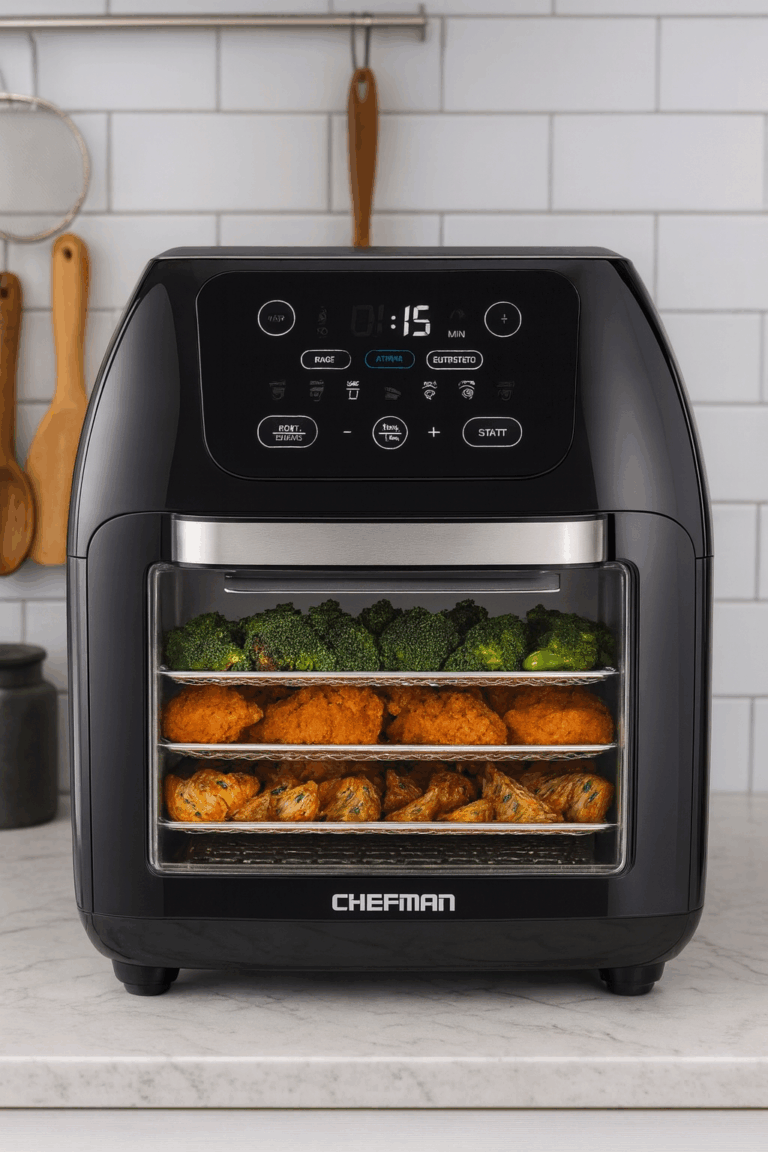
Unlike multi-rack oven-style models, single-basket airflow depends entirely on vertical circulation.
This means shaking matters more in large baskets than many buyers expect.
The LED reminder reduces uneven browning by prompting action at the right time.
Tradeoff: Strong airflow power, but still dependent on spacing discipline.
Decision cue: If you expect “set it and forget it” perfection without shaking, you will be disappointed. If you follow airflow basics, crisping performance is reliable.
Single Basket vs Dual Basket: What You Give Up
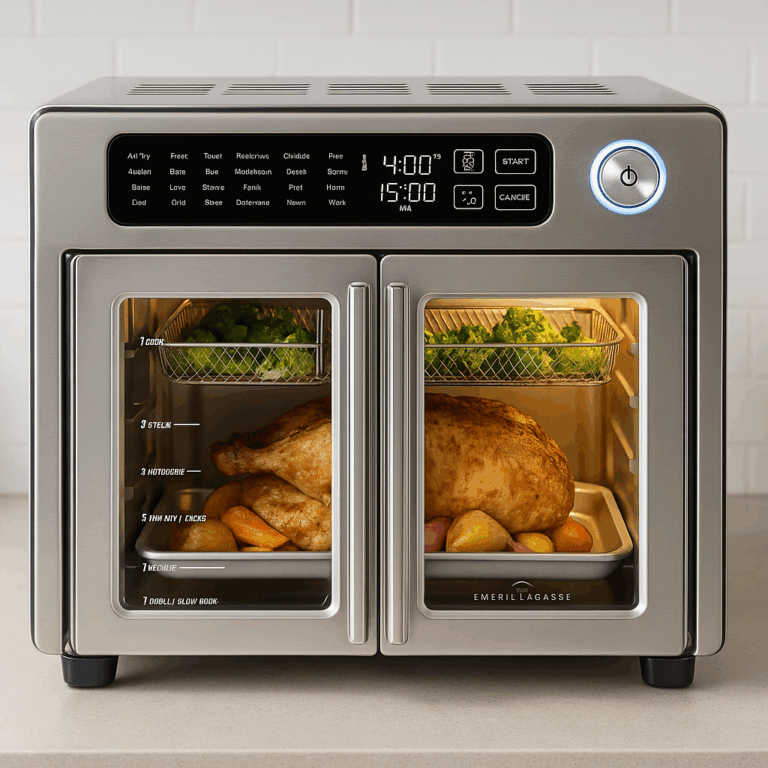
The TurboFry is a large single-basket model.
This simplifies cooking.
However, it removes independent zone control.
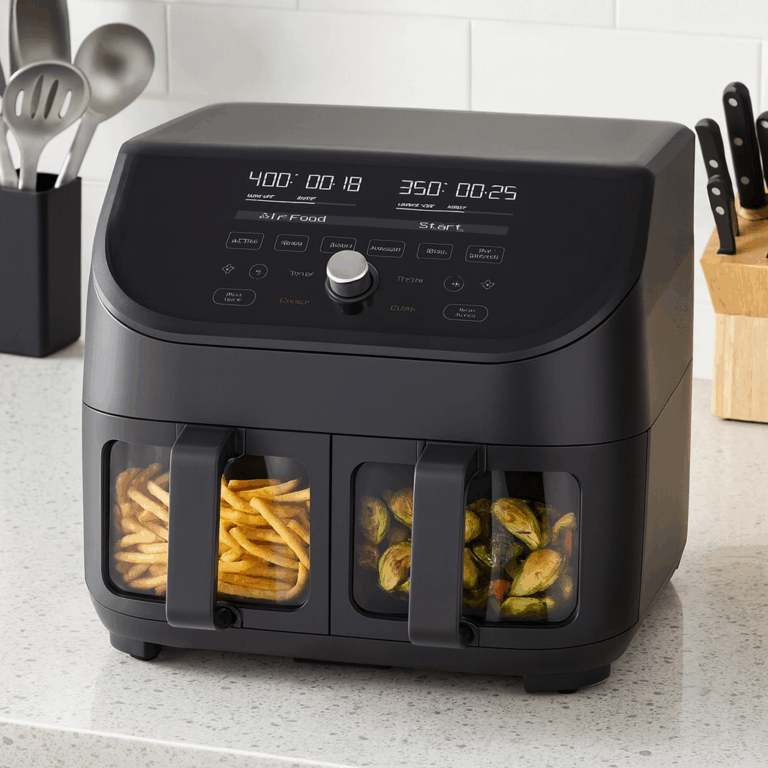
With a dual-basket air fryer, you can:
- Cook chicken at 400°F
- Cook vegetables at 375°F
- Sync finish times
With the TurboFry:
- Everything shares one temperature
- Everything shares one timer
This works perfectly when cooking one type of food.
It becomes limiting when preparing multi-component dinners.
Families who cook protein and sides separately may notice this constraint.
The tradeoff is simplicity.
You avoid managing two baskets.
You avoid extra cleaning.
You avoid coordinating two sets of controls.
Bottom line: If you value simplicity over precision timing flexibility, single-basket capacity wins.
After 30 to 60 Days: Does It Still Feel Worth It?
Large basket satisfaction depends on routine.
If you cook dinner for multiple people most nights, the 8QT space continues to feel valuable.
If your cooking frequency drops, it begins to feel oversized.
Most regret occurs when:
- Families shrink
- Users move to smaller apartments
- Cooking volume decreases
Bottom line: It rewards consistent use. It feels excessive if underused.
Real Ownership Friction After Month One
The first week feels impressive.
By week four, patterns settle.
Here is what owners typically notice.
Counter Permanence
This becomes a permanent countertop appliance. Moving an 8QT unit daily is unrealistic.
Cleaning Frequency
Large baskets collect more grease per cycle. If you cook wings often, quick wipes become necessary to avoid smoke later.
Noise Familiarity
What feels loud at first becomes background noise after regular use.
Space Discipline
Overfilling causes longer cook times. Owners who learn spacing techniques remain satisfied. Those who do not often blame the machine.
Bottom line: Long-term satisfaction depends more on user habits than hardware limitations.
What Causes Buyers to Regret 8QT Models
Regret appears in predictable patterns.
Downsizing
If children leave home or cooking volume decreases, 8QT begins to feel excessive.
Small Kitchens
Counter space tension builds over time in tight kitchens.
Lifestyle Shift
Busy schedules that reduce home cooking make large appliances feel unnecessary.
Expectation Mismatch
Buyers expecting oven-level baking precision feel underwhelmed.
Returns rarely happen because of food quality.
They happen because of a size mismatch.
Decision cue: Buy for consistent family volume, not occasional hosting.
Durability and Long-Term Wear
Large baskets see heavier usage.
Basket Coating
The nonstick coating holds up well when silicone or wooden utensils are used.
Metal tools shorten lifespan significantly.
Heating System
1700 watts provides strong airflow. Performance remains consistent when vents stay clean.
Touchscreen Panel
Responsive and easy to wipe. Avoid excessive moisture exposure.
Expected lifespan aligns with other mid-range family air fryers.
Maintenance Habits That Extend Its Life
Large air fryers collect grease faster because they cook more food at once.
A quick wipe after each use prevents buildup.
Dishwasher-safe components simplify cleanup, but occasional hand washing preserves coating quality.
For deeper care guidance, including grease prevention and airflow maintenance, review this complete air fryer maintenance guide that explains long-term care habits.
Neglect shortens airflow performance more than most buyers expect.
Energy Use and Weekly Efficiency
The TurboFry runs at 1700 watts.
Traditional ovens often draw double that.
For meals serving four to five people, it is more energy-efficient than heating a full oven cavity.
However, for holiday-scale cooking, ovens remain more volume-efficient.
Bottom line: It is optimized for family weeknight meals, not event catering.
Does It Replace Your Oven?
For weeknight dinners, often yes.
For large baking trays or multiple racks, no.
It replaces:
- Roasted vegetables
- Chicken dinners
- Frozen snacks
- Reheating
It does not replace:
- Multi-tray baking
- Large casseroles
- Holiday meals
Decision cue: Strong weeknight replacement, partial oven substitute.
Cost Per Use: Is the 8QT Worth the Space?
Value depends on frequency.
If used four to six nights per week, the cost per use drops significantly over a year.
If used occasionally, the size may feel unjustified.
Compared to smaller units, it saves time through reduced batching.
Compared to dual-basket units, it simplifies workflow at a slightly lower cost.
What a Full Week of Family Cooking Looks Like
To understand real value, examine the routine.
Monday:
Chicken thighs and green beans for five.
Tuesday:
Reheat leftovers and crisp frozen fries.
Wednesday:
Frozen chicken nuggets and vegetables.
Thursday:
Roasted sweet potatoes and salmon portions.
Friday:
Batch cook wings for family movie night.
Saturday:
Light snack reheating.
Sunday:
Rest day or oven use for a larger meal.
Notice the pattern.
The TurboFry reduces oven usage during weekdays.
It handles high-volume proteins easily.
It simplifies reheating without sogginess.
If your week looks similar, the 8QT size integrates smoothly.
If your cooking frequency is low, the size advantage shrinks.
Counter Space and Storage Reality
An 8QT unit requires:
- Rear ventilation clearance
- Side space for heat dispersion
- Dedicated plug access
In large kitchens, this is irrelevant.
In small kitchens, this becomes a daily visibility factor.
Weight makes cabinet storage inconvenient.
Most owners leave it on the counter permanently.
Tradeoff: Capacity efficiency versus countertop footprint.
Is 8QT the Sweet Spot or Overkill?
For families of four to six, 8QT eliminates second rounds.
For families of three or fewer, it may feel slightly oversized.
Compared to 6QT:
- More spacing flexibility
- Better airflow consistency
- Fewer crowding issues
Compared to 10QT or oven-style:
- Simpler cleaning
- Smaller footprint
- Less complexity
8QT sits in the middle ground.
Large enough for families.
Simple enough for daily use.
Bottom line: It is the sweet spot for mid-size households but excessive for minimal cooking routines.
Who This Air Fryer Is For
Best for:
- Families of four to six
- Busy weeknight cooks
- Users who dislike managing multiple baskets
- People who want preset simplicity
- Batch cooking meal preppers
Who Should Avoid It
Not ideal for:
- Small kitchens
- Solo cooks
- Minimalist counter setups
- Users wanting dual-zone cooking
Reality check: It is built for family volume, not small portions.
Before You Buy: Practical Questions Families Still Ask
Is 8QT too big for a family of four?
No. It eliminates second batches and gives spacing flexibility.
Does the shake reminder really help?
Yes. It improves consistency, especially for fries and wings.
Is it difficult to clean?
No. Dishwasher-safe basket and regular wipe-downs keep maintenance manageable.
Can it cook frozen foods directly?
Yes. Frozen fries, nuggets, and wings cook well without thawing.
Is it loud?
Moderately loud at high heat, typical for large basket air fryers.
Final Takeaway
The Chefman TurboFry Touch 8QT is a convenience-focused family air fryer.
It saves time.
It reduces batching.
It simplifies cooking through presets and reminders.
It takes space.
It makes moderate noise.
It does not offer advanced multi-zone features.
Choose it if you cook real dinners for multiple people regularly.
Skip it if you cook small portions or want specialty cooking modes.
For broader comparisons across sizes and features, revisit the complete air fryer review hub to see how different capacities match different households before making your final decision.