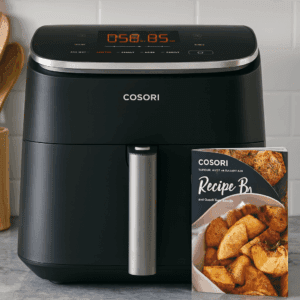
The COSORI Air Fryer 9-in-1 positions itself as the balanced choice.
Not too big.
Not too small.
Not too complicated.
It offers 450°F high heat, quiet operation, and multiple cooking modes inside a 6QT format.
But here is the real question.
Is this actually the best all-around air fryer for most households, or is it just well-marketed?
This review answers that using real dinner tests, long-term ownership insights, and regret triggers.
If you want to compare this model against other top performers across sizes, start with this full air fryer review hub that breaks down which capacity fits which household.
Verdict
The COSORI 9-in-1 is worth buying if you want a 6QT air fryer that balances performance, noise control, and versatility without stepping into oversized territory.
It performs especially well for families of three to five.
Its biggest strength is high-heat crisping with relatively quiet airflow.
Its biggest drawback is that it does not eliminate batch cooking for larger families.
If you want a “safe” mid-size choice that rarely disappoints, this model makes sense.
If you need extreme capacity or dual cooking zones, look elsewhere.
Table of Contents
What Makes the COSORI 9-in-1 Different From Typical 6QT Models
Most 6QT air fryers stop at 400°F.
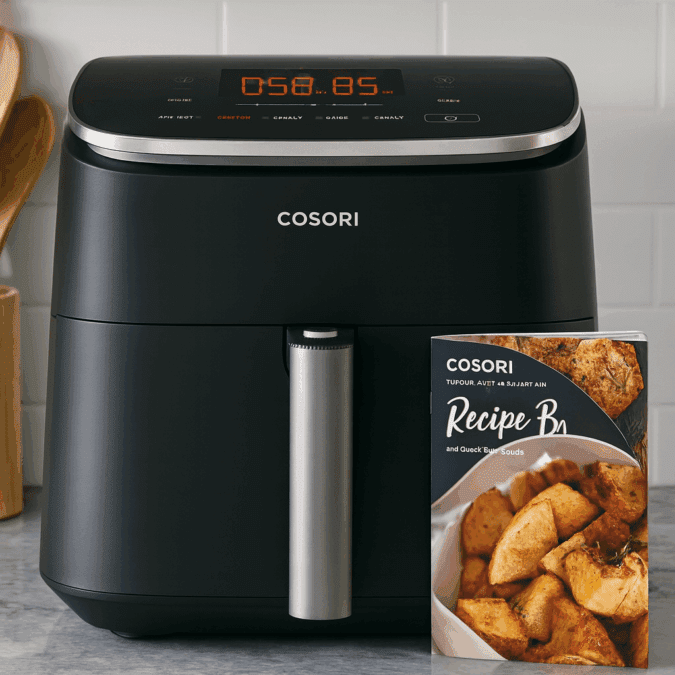
The COSORI reaches 450°F.
That difference is not cosmetic.
Higher heat improves:
- Chicken skin crisping
- Frozen food browning
- Surface texture on breaded foods
- Faster finishing time
TurboBlaze Technology uses five fan speeds to maintain even airflow.
The result is more consistent browning with fewer cold spots.
Noise output stays under 53 dB, which is quieter than many comparable 6QT models.
Best for: Families who want performance without aggressive fan noise.
6QT Capacity Reality: Is It the True Sweet Spot?
6QT sits in the middle of the air fryer size spectrum.
It comfortably fits:
- 3 medium chicken breasts
- 1.5 to 2 pounds of fries
- Vegetables for four
- 8 to 10 wings with spacing
It does not comfortably fit:
- Meals for six without stacking
- Large casseroles
- Two distinct dishes simultaneously
The advantage of 6QT is balance.
It avoids the counter dominance of 8QT models.
It avoids the batching frustration of compact 4QT models.
Decision cue: If your household feels slightly too big for compact models but slightly too small for oversized units, 6QT is often the safest middle ground.
Counter Space and Kitchen Fit Reality
A 6QT air fryer sits in the middle range physically as well.
It requires:
- Rear ventilation clearance
- Side spacing for airflow
- Dedicated plug access
It does not dominate a counter like many 8QT models, but it is not compact.
Most owners leave it permanently on the counter.
In small apartments, this becomes a visible fixture. In larger kitchens, it blends easily.
Cabinet storage is possible but inconvenient due to the weight.
Best for: Mid-size kitchens with regular counter space.
Watch out for: Expecting it to store away daily.
What Cooking a Real Dinner Looks Like
Dinner Test: Salmon, Baby Potatoes, and Green Beans
Setup:
Two salmon fillets centered
Baby potatoes around the perimeter
Green beans are lightly layered
Temperature: 425°F
Traditional oven:
10 to 15 minutes preheat
20 to 25 minute cook
Total: 35 to 40 minutes
COSORI:
2 to 3 minutes preheat
16 to 20 minutes cook
Total: 18 to 23 minutes
You save roughly 15 minutes.
The higher heat ceiling produces better salmon edge crisping than standard 400°F models.
Potatoes brown evenly when shaken once mid-cycle.
Noise remains steady and less sharp than many larger-capacity units.
Kitchen heat output is minimal compared to oven cooking.
If you cook weeknight meals for four, this workflow feels efficient and controlled.
450°F High Heat: Marketing or Meaningful?
The jump from 400°F to 450°F improves browning speed.
It creates:
- Faster crisping on frozen fries
- Better blistered chicken skin
- Stronger surface caramelization
However, higher heat reduces the margin for overcrowding.
Stacked food will brown unevenly faster at 450°F.
Tradeoff: Greater crisping power with slightly less forgiveness.
If crisp texture is your priority, the higher ceiling matters.
Airflow Discipline: Why Some Users Get Uneven Results
High heat alone does not guarantee even cooking.
Air fryers depend entirely on airflow circulation. When food blocks vertical airflow, browning suffers.
The COSORI performs best when:
- Food sits in a single layer
- There is visible spacing between pieces
- Dense proteins are flipped midway
Uneven cooking complaints usually come from:
- Overcrowded baskets
- Stacked fries
- Large protein pieces are blocking lower airflow
The 450°F capability increases browning power, but it also increases sensitivity to overcrowding.
Shaking once during cooking dramatically improves consistency.
Decision cue: If you are willing to respect airflow spacing, performance is strong. If you expect oven-style stacking freedom, results will vary.
Noise Reality: Is Under 53 dB Noticeable?
COSORI promotes quieter airflow.
In practice:
At moderate temperatures, sound is smooth and steady.
At high heat, airflow increases but remains less harsh than many 8QT models.
In open kitchens, it blends into background activity.
In small apartments, it is still audible but not disruptive.
Watch out for: Expecting silence. It is quieter than average, not silent.
Where the COSORI Frustrates Owners
Batch Cooking for Larger Families
For five or six people, two rounds may still be necessary.
No Dual-Zone Flexibility
Everything cooks at one temperature.
Protein and vegetables must share heat settings.
Capacity Expectations
Some buyers expect 6QT to replace a full oven entirely. It does not.
Tradeoff: Balanced size versus maximum capacity.
Single Basket vs Dual Basket: Is One Zone Enough?
The COSORI uses a single large basket.
This simplifies the operation. You control one temperature and one timer.
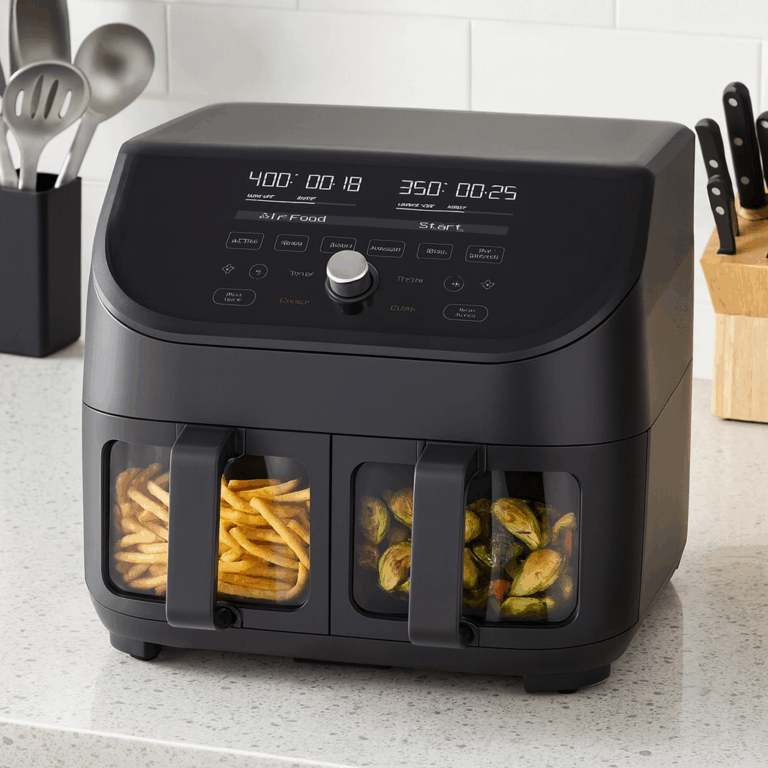
Dual-basket models allow separate temperatures for protein and sides.
However, dual baskets also mean:
- More cleaning
- Smaller individual basket sizes
- More controls to manage
For families cooking one main dish at a time, a single basket is simpler and faster.
For households regularly cooking two distinct foods simultaneously at different temperatures, dual baskets offer flexibility.
Tradeoff: Simplicity versus independent zone precision.
Decision cue: If you value streamlined cooking over multi-zone coordination, a single basket is often enough.
After 30 to 60 Days: What Ownership Actually Feels Like
The first week highlights speed.
By week four, routine defines satisfaction.
Most owners use it for:
- Weeknight proteins
- Frozen snacks
- Vegetable sides
- Reheating leftovers
Oven usage decreases significantly during weekdays.
Regret appears mainly when hosting increases or the family size grows.
Bottom line: It rewards stable mid-size households.
What a Full Week of Cooking Looks Like
To understand real value, examine the routine.
Monday:
Chicken breasts and green beans for four.
Tuesday:
Reheat leftovers and crisp frozen fries.
Wednesday:
Frozen nuggets and roasted vegetables.
Thursday:
Salmon fillets and asparagus.
Friday:
Wings for movie night.
Saturday:
Quick breakfast hash.
Sunday:
Light use or oven for a larger family meal.
The pattern shows why 6QT works well.
It handles weeknight meals easily.
It reduces oven use.
It avoids the bulk of oversized models.
If your week resembles this rhythm, the size integrates smoothly.
If you host large gatherings often, you may wish for more volume.
Durability and Long-Term Wear
Basket Coating Lifespan
The nonstick coating holds up well when silicone utensils are used.
Metal tools reduce lifespan significantly.
Heating and Airflow Consistency
Performance remains stable when vents stay clean.
Grease buildup impacts airflow more than most buyers expect.
Touchscreen Panel Reliability
The digital panel is responsive and easy to wipe clean.
Avoid excessive moisture exposure.
Expected lifespan aligns with other premium mid-range models.
Maintenance Habits That Protect Performance
A quick wipe after greasy foods prevents smoke buildup.
Dishwasher-safe parts simplify cleanup.
Occasional hand washing preserves the coating longer.
Neglect reduces crisping performance over time.
Energy Use and Weekly Efficiency
Most 6QT air fryers operate around 1700 watts.
Traditional ovens often draw double that power.
For small-to-medium dinners, the COSORI is more energy-efficient.
For holiday-scale cooking, ovens remain superior.
Bottom line: More efficient for regular weeknight use.
Does It Replace Your Oven?
For many households, yes, during the week.
It replaces:
- Roasted vegetables
- Chicken dinners
- Frozen snacks
- Quick-baked items
- Breakfast items like hash browns
It often replaces toaster ovens and reduces microwave usage for foods that need a crisp texture.
However, it does not replace:
- Multi-rack baking
- Large sheet pans
- Holiday cooking
- Large casseroles
Energy use remains lower for small-to-medium meals compared to heating a full oven cavity.
In the summer months, reduced ambient heat is noticeable.
Bottom line: It significantly reduces oven reliance but does not eliminate the need for traditional baking capacity.
How It Compares to Other Sizes
Compared to 4QT:
- Less batching
- More spacing flexibility
- Slightly larger footprint
Compared to 8QT:
- Easier storage
- Less counter dominance
- May require an occasional second batch
If you want to compare this against top-rated models across price and capacity tiers, review this curated best air fryer roundup highlighting standout performers in each category.
Cost Per Use: Is It Worth the Mid-Range Price?
The COSORI sits slightly above entry-level pricing.
If used four to five times weekly, the cost per use becomes minimal over a year.
Its value lies in:
- Higher heat capability
- Balanced capacity
- Quieter operation
If used rarely, cheaper models may suffice.
Upgrade Path: When Do People Outgrow 6QT?
6QT is often an upgrade from compact 4QT models.
It solves batch frustration for most families of four.
However, upgrade triggers appear when:
- Teenagers eat adult-sized portions
- Hosting becomes frequent
- Meal prepping increases
- Larger protein cuts become routine
Most people upgrading from 6QT move into 8QT or dual-basket systems.
Others who downsize from 8QT often land on 6QT as the balanced compromise.
Decision cue: If your household is stable at three to five people, 6QT remains sustainable long term. If growth is expected, consider sizing up now.
Who This Air Fryer Is For
Best for:
- Families of three to five
- Users wanting strong crisping performance
- Households valuing quieter operation
- Kitchens that cannot accommodate oversized units
Who Should Avoid It
Not ideal for:
- Large families needing 8QT+
- Dual-zone cooking demands
- Minimal counter setups
- Solo snack cooks
Reality check: It thrives in balanced households, not extremes.
Before You Buy: Practical Questions Buyers Still Ask
Is 6QT Big Enough for Four People?
Yes, a 6QT air fryer is generally enough for four people when food is arranged in a single layer with proper spacing. It comfortably handles a protein and a side for most weeknight meals. However, for larger appetites or entertaining guests, you may occasionally need to cook in two rounds.
Does 450°F Really Matter?
Yes, the 450°F maximum temperature makes a noticeable difference in crisping performance. It helps frozen foods brown faster and improves the texture of chicken skin and breaded items. The higher heat also shortens cook time slightly when food is spaced properly.
Is It Easy to Clean?
Yes, the nonstick basket and dishwasher-safe components make cleanup straightforward. Most residue releases easily with warm water and mild soap. Regular light cleaning prevents grease buildup that can affect airflow over time.
Is It Loud?
It operates more quietly than many comparable models, especially at moderate temperatures. At higher heat settings, airflow becomes more noticeable but remains steady rather than sharp or rattling. In most kitchens, it blends into normal background appliance noise.
Does It Replace the Oven Completely?
No, it significantly reduces oven use for weeknight meals but does not fully replace it. It handles roasted vegetables, proteins, and frozen foods efficiently. Larger sheet-pan meals, multi-rack baking, and holiday cooking still favor a traditional oven.
Final Takeaway
The COSORI Air Fryer 9-in-1 delivers balanced performance in a mid-size format.
It is not extreme.
It is dependable.
It combines higher heat capability with controlled noise and a manageable footprint.
Choose it if your household sits between compact and oversized needs.
Skip it if you require dual cooking zones or maximum volume.
For most mid-size families, it remains one of the safest and most balanced air fryer choices available.