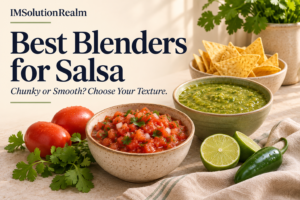
The best blender for salsa should give you control over when to stop. That matters more than choosing the machine with the largest power number. A few extra seconds can turn chopped tomatoes, peppers, and onions into a smooth sauce.
For a conventional pitcher blender, the Vitamix E310 is our first choice for buyers who want direct speed control and Pulse. The KitchenAid K400 offers another approach with five manual speeds and Pulse. If chunky salsa is your main priority, consider the Ninja BN801 for its separate food processor bowl.
These recommendations serve different routines. None guarantees the texture you want without the right preparation, batch size, and blending method.
For other uses, browse our buying guides matched to what you make.
Our Salsa Picks at a Glance
| Model | Main reason to consider it | Important limitation |
|---|---|---|
| Vitamix E310 | Ten manual speeds and Pulse in a 48-ounce pitcher | Requires you to monitor texture; no automatic salsa program |
| KitchenAid K400 | Five manual speeds and Pulse for a conventional pitcher setup | Drink presets are not a substitute for watching salsa texture |
| Ninja BN801 | Separate processor bowl for chopped mixtures, plus a blender pitcher | More parts to store; not for blending hot ingredients |
Table of Contents
Start With the Salsa You Actually Want
“Salsa” covers several textures. Choosing the appliance becomes easier once you decide which one you make most often.
A smooth red salsa or blended tomatillo sauce suits a pitcher blender. You want the ingredients to combine into a pourable mixture, so the blender’s ability to reduce pieces is useful.
Chunky salsa presents a different task. You want smaller pieces without fully breaking down every ingredient. Short pulses, sensible preparation, and frequent checks matter more here.
Pico de gallo is another distinction. If you want neat pieces of tomato and onion, hand chopping gives you direct control over their size. Buying a powerful blender solely for that result is hard to justify.
Think about how you serve salsa, too. A spoonable dip for chips may need more body than a sauce you drizzle over tacos. Neither texture is inherently better. The right machine should fit the result you prefer.
Vitamix E310: Our Pick for Direct Manual Control
The Vitamix E310 is the strongest starting point on this shortlist if you want a conventional blender for salsa and other kitchen tasks.
Its standard setup includes a 48-ounce container. The controls provide ten variable speeds and a separate Pulse switch. Importantly, the Pulse function operates at the speed selected on the dial, giving you control over both speed and duration.
That combination matters when you alternate between a textured dip and a smoother sauce. You can make a deliberate adjustment rather than relying only on how long a fixed-speed machine runs.
Why it earns a place here
The E310’s appeal is its control layout. There is no need to choose a smoothie program and hope it stops at the right point for tomatoes.
A cook who likes to watch the mixture and make small changes may prefer that approach. It also avoids buying a multi-container kitchen system when all you want is a pitcher blender.
The 48-ounce container is relevant for households that do not need the largest full-size pitcher. However, its stated capacity is not a recommended salsa batch size or a promise that it can process any tiny portion.
Follow a compatible recipe and leave the space the instructions require.
What would change our recommendation?
The E310 is less compelling if you only want occasional chopped salsa and already own a useful blender. A separate chopper, food processor, or knife may fill that gap more directly.
It also asks you to stay involved. Manual control gives you choices, but you must watch the food and stop before it becomes smoother than intended.
Our take: Choose the E310 if salsa is one of several jobs you want from a manually controlled pitcher blender. Skip it if your only goal is neatly diced ingredients.
KitchenAid K400: An Alternative With Five Manual Speeds
The KitchenAid K400 suits buyers who want a conventional pitcher blender with a smaller set of manual speed choices.
Its controls include five manual speeds, Pulse, and separate programs for ice crushing, icy drinks, and smoothies. KitchenAid’s documentation covers multiple container options, so check the jar and accessories included with the exact package you buy.
For salsa, the manual controls are the relevant feature. The drink programs have different goals and should not guide the purchase.
Where the K400 makes sense
Five speeds can be enough for someone who prefers fewer settings to consider. Pulse lets you work in short bursts and inspect the result between them.
The buying decision is not simply whether ten speeds beat five. The useful question is whether the controls let you manage your recipes in a way that feels straightforward.
The K400 belongs on this shortlist as an alternative pitcher setup. We have not established that it produces more even chunks or smoother salsa than the E310.
If you want more background before choosing a model, explore our collection of detailed blender evaluations.
The limitations to weigh
The K400 remains a blender, rather than a dedicated solution for diced salsa. You can still overprocess soft tomatoes while trying to reduce larger pieces of onion or pepper.
A large jar also does not solve the problem of a very small batch. Ingredients need to engage with the blades rather than sit outside their reach. Adding extra water solely to make an undersized batch move may leave you with a thinner salsa than planned.
Our take: Consider the K400 if you want a pitcher blender with five manual speeds and Pulse. Choose based on the complete appliance and package, rather than expecting its presets to handle salsa automatically.
Ninja BN801: For Buyers Who Also Want a Processor Bowl
The Ninja BN801 earns its place for a different reason: it combines a blender with a separate food processor bowl.
The system includes a 72-ounce pitcher with a 64-ounce maximum liquid capacity, plus a processor bowl. Its controls include manual Pulse, and the processor has a Chop program. The manufacturer’s instructions prohibit blending hot liquids and require careful handling of its removable blade assemblies.
For someone choosing between a blender and food processor, that separate bowl is more relevant than the motor’s advertised peak power.
Why the bowl changes the decision
If you regularly want chopped salsa, a processor bowl gives you an alternative to working only in a tall blender pitcher.
You can choose the vessel that matches the task rather than expecting one container to handle every texture equally well. That makes the BN801 worth considering for a household that also wants general chopping and blending functions.
It does not mean the Chop program guarantees your preferred salsa. Start with the model’s instructions and a suitable recipe. Check progress rather than assuming one complete program will suit every combination of vegetables.
What you give up
The system takes more storage space and involves more components than a pitcher-only blender.
You also need to handle the removable blades carefully during preparation, emptying, and cleaning. Those steps matter if you want an appliance that is quick to take out for a small bowl of salsa.
For roasted or boiled ingredients, allow them to cool before using this model. Its large pitcher does not make it suitable for hot blending.
Our take: Choose the BN801 when you want both blending and food processing. If you already own a blender and mainly need chopped salsa, a standalone processor may be a more focused purchase.
Blender or Food Processor for Salsa?
A blender is a sensible choice when your goal is a cohesive sauce. A food processor deserves a closer look when you want chopped pieces.
There is overlap, and technique can change the result. Still, it helps to buy around your main use rather than an occasional exception.
For example, someone who makes smoothies every morning and smooth salsa twice a month has a clear reason to choose a blender. Someone who already owns a blender but wants chunky dips and vegetable chopping may gain more from a processor.
You do not need to buy another appliance if your current one already makes salsa you enjoy. Try adjusting preparation and blending time first.
Likewise, none of these machines replaces careful knife work when you want uniform dice. A motorized blade keeps cutting whichever pieces reach it; it does not measure each piece before moving on.
How to Keep Chunky Salsa From Becoming Purée
Give the ingredients a reasonable starting size before blending. A large piece of onion and a soft tomato do not need the same amount of cutting.
If the tomato breaks down while the onion remains large, continuing to blend the entire batch can push the texture further from your goal. More power does not resolve that mismatch.
Follow a recipe designed for your container, then check the mixture after short pulses. Allow the blades to stop fully before opening the lid. Turn off and unplug the appliance before scraping or repositioning ingredients with a utensil.
Keep some ingredients separate if the recipe calls for adding them later. Stirring in prepared pieces at the end can create texture without asking the blender to reduce everything at once.
The key is to stop when the salsa reaches your preference. Once the whole batch becomes smooth, more blending cannot restore the pieces.
Why Does Blender Salsa Turn Watery?
Look at the ingredients and preparation before blaming the blender.
Tomatoes contribute liquid. Added water, undrained canned tomatoes, and juices from cooked vegetables can change the balance further. Breaking the ingredients down also changes how the mixture holds together.
For your next batch, consider where the liquid enters the recipe. Drain ingredients when the recipe calls for it, and avoid adding water merely because a few pieces are not moving.
If the batch is too small or the pieces are poorly prepared, extra liquid may help circulation while creating a different problem in the serving bowl.
A fine-mesh strainer can remove some excess liquid from a finished batch. However, it will not restore chunks after overblending, and draining can affect seasoning. Taste the salsa again afterward.
For more preparation and operating guidance, browse our practical guides to using your blender.
Roasted Ingredients Need a Temperature Check
A recipe that calls for roasted tomatoes does not automatically suit every blender straight from the oven.
Check the exact appliance and container instructions before processing warm or hot food. Limits can differ between a full-size pitcher and a personal cup, even within one product system.
The simplest approach for this guide is to cool cooked ingredients before blending. In particular, the Ninja BN801 is not a hot-blending option.
Do not improvise by loosening a lid or removing parts from a container that is not approved for hot ingredients. Follow the manufacturer’s directions for the equipment you own.
This buying guide covers appliance selection and texture. It does not provide instructions for canning salsa.
Choose Around Your Most Frequent Batch
Before ordering, picture the batch you make most often.
Is it one small bowl for dinner or enough for several guests? Do you want a pourable taco sauce, a textured dip, or distinct diced pieces? Will the appliance also make drinks and other foods?
Those answers help separate these three options:
- Vitamix E310: Our first choice here for a conventional pitcher blender with direct speed and Pulse control.
- KitchenAid K400: An alternative for buyers who prefer five manual speeds and a straightforward pitcher setup.
- Ninja BN801: The more relevant option when a separate processor bowl would serve your chopping needs.
If chunky salsa is your only reason to shop, start by deciding whether you need a blender at all. If smooth salsa and broader blending are the priorities, the E310 is the clearest starting point on this shortlist.