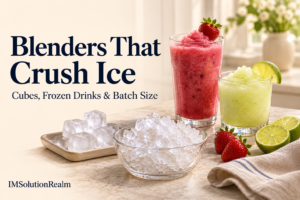
Choosing a blender for ice starts with what you want to make. Crushed ice for serving drinks is a different task from blending ice with fruit, juice, or other ingredients.
That distinction changes the equipment and instructions you need. Some models explicitly support crushing plain ice. Others permit ice within a liquid-based recipe, with restrictions that depend on the vessel.
Our shortlist includes the KitchenAid K150 for smaller batches and a straightforward ice-crush control, the Ninja BN701 for a large pitcher focused on frozen drinks, and the Vitamix Propel 750 for buyers who want manual control and broader kitchen use.
If ice is only one of your priorities, explore our blender recommendations for a range of kitchen tasks.
Quick Verdict
The KitchenAid K150 is the clearest starting point here if you want smaller batches of plain crushed ice. Its instructions specifically describe that task.
Consider the Ninja BN701 when your main goal is a pitcher of frozen drinks, and you do not need personal blending cups.
Choose the Vitamix Propel 750 when ice is part of a wider range of recipes, and you value variable speed, pulse, and an included tamper.
These choices reflect documented features and intended uses. We are not declaring a laboratory performance winner.
Table of Contents
Our Ice-Crushing Blender Shortlist
| Blender | Recommended use | Relevant equipment or control | Main tradeoff |
|---|---|---|---|
| KitchenAid K150 | Smaller batches of crushed ice | 48-ounce jar and hold-to-run Ice Crush/Pulse control | Its documented ice quantity is much smaller than a full jar |
| Ninja BN701 | Shared batches of frozen drinks | Large pitcher, automatic programs, and manual controls | No personal cup in the standard pitcher-only package |
| Vitamix Propel 750 | Ice alongside broader kitchen tasks | 64-ounce container, variable speed, pulse, and tamper | More equipment and capability than occasional ice crushing may justify |
Advertised pitcher capacity does not establish how much ice you can process. Follow the instructions for the exact model and vessel.
Decide Between Crushed Ice and a Frozen Drink
Plain crushed ice is an ingredient. You might use it to fill a glass, chill a serving bowl, or prepare a drink afterward.
A frozen drink combines ice with other ingredients during blending. Its final consistency depends on the recipe as well as the appliance.
A blender that permits ice within a smoothie is not automatically approved to run with a pitcher or cup full of ice alone. Likewise, instructions for a full-size pitcher should not be transferred to a personal cup.
This is the first question to resolve before comparing motor ratings: does the manufacturer permit the task in the vessel you will use?
Next, consider the amount you need. A small batch for two glasses creates a different routine from preparing several pitchers for guests. A large container may help with drinks, but you still need to respect ingredient limits and operating instructions.
KitchenAid K150: For Smaller Batches of Plain Crushed Ice
The KitchenAid K150 offers three speeds and an Ice Crush/Pulse setting. The standard KSB1325 configuration uses a 48-ounce jar.
Its most useful distinction is the detail in its instructions. KitchenAid recommends half a standard ice tray, or approximately seven to eight standard cubes, at a time. The guide says the Ice Crush function is optimized to crush ice without added liquid.
That gives buyers a concrete starting point. It also prevents a common mistake: interpreting a 48-ounce jar as permission to fill it with solid ice.
The control requires attention. You hold the dial in the Ice Crush/Pulse position and release it to stop. It is not an automatic cycle that decides when your preferred texture has been reached.
Why we would consider it: Its documented plain-ice method and limited batch size make its intended use clear.
What to weigh: Preparing a larger quantity may require several batches. Someone serving a crowd should consider that workflow before choosing it.
KitchenAid advertises crushing half a tray in less than ten seconds. That is a manufacturer claim for a stated quantity, not a result we have independently reproduced. Different cube sizes should not be assumed to produce the same result.
Our take: The K150 is worth considering for modest amounts of crushed ice and buyers who prefer a simple dial. Confirm the full model number because packages with personal jars differ from the basic configuration.
Ninja BN701: For Large-Pitcher Frozen Drinks
The Ninja BN701 focuses on full-size pitcher blending. Ninja lists a 72-ounce Total Crushing pitcher with a 64-ounce maximum liquid capacity and describes the model for ice, smoothies, and frozen drinks.
Its appeal is straightforward: a larger vessel for shared drinks without buying a kitchen system full of attachments.
The BN700-series guide describes automatic programs alongside manual controls. Exact functions can vary within a series, so match the instructions to the BN701 and its control panel rather than assuming every related model is identical.
Why we would consider it: The package concentrates on pitcher use, which suits households preparing several servings together.
What to weigh: It is less convenient if your usual task is one small takeaway drink. The standard package does not provide a personal blending cup.
The removable stacked blade assembly also changes the cleaning and pouring routine. Follow the instructions for handling it; do not treat it like a permanently fixed blade at the bottom of a pitcher.
Ninja advertises 1,400 peak watts. That is a peak rating, not a direct measure of finished texture, crushing speed, or durability. It should not decide the purchase by itself.
Our take: Consider the BN701 primarily for shared frozen drinks. Before buying it specifically for plain crushed ice, confirm the relevant instructions and quantities rather than relying on the product name alone.
Vitamix Propel 750: For Ice and Wider Kitchen Use
The Vitamix Propel 750 includes a 64-ounce low-profile container and tamper. It provides variable speed, pulse, blending programs, and a cleaning program. The standard product carries a seven-year limited warranty.
The reason to consider it is versatility. If you also prepare sauces, soups, dips, and other blended foods, a larger set of controls may have value beyond frozen drinks.
Pulse lets you apply short bursts rather than committing to continuous blending. Vitamix identifies ice crushing as one use for pulse, but the quantity and method should still follow the guidance for your model and container.
Why we would consider it: It offers manual adjustment and a tamper for suitable recipes, with a large container for multiple servings.
What to weigh: It may be difficult to justify solely for occasional crushed ice. The warranty is useful ownership information, but it does not prove an individual appliance will last a particular number of years.
Its programs also should not be confused with a dedicated automatic ice-crushing function. Choose the appropriate documented method for the task.
Our take: The Propel 750 makes more sense as a main kitchen blender than as a specialist ice crusher. Choose it when its broader capabilities will receive regular use.
What Matters More Than a Large Wattage Number?
Start with explicit permission to process ice. Then compare the controls, permitted quantities, serving size, and cleaning routine.
Power figures can describe different things. Peak watts, electrical ratings, and horsepower are not interchangeable measures of real-world results.
A useful comparison asks what you can actually do with the appliance. Can you stop easily at a coarse texture? Does the manufacturer specify a small ice batch? Does the pitcher suit several drinks? Is the blade arrangement comfortable for you to clean?
Replacement equipment deserves attention too. Check the availability and compatibility of pitchers, lids, and blade assemblies. A similar-looking part is not enough to establish that it fits safely.
For more detail on individual designs, browse our model-by-model blender research and ownership notes.
Ice and Frozen Fruit Are Different Buying Questions
A blender’s ability to break ice does not establish how smoothly it processes every frozen-fruit recipe.
Frozen drinks can contain ingredients with different sizes, shapes, and textures. Seeds, fruit skins, and fibrous ingredients introduce questions that plain crushed ice does not answer.
Consider your usual recipe rather than choosing from an ice-crushing claim alone. A person making blended fruit drinks needs evidence relevant to those drinks.
Likewise, a buyer who only wants crushed ice may not benefit from paying for a wide range of smoothie programs.
Keep the comparison tied to your intended use. We have not measured fruit texture or ice-particle consistency for these models, so those results should not be inferred from their specifications.
Can a Personal Blender Crush Ice?
Some personal blenders permit ice in suitable recipes, but that is not permission for every model to process ice alone.
Check the manual for the exact cup and blade assembly. A motor base that accepts more than one vessel may have different restrictions for each.
Also account for serving size. A personal cup may suit one drink, while repeated rounds become inconvenient for a group.
The travel lid is another separate feature. It helps you carry the finished drink; it does not make the blender suitable for larger ice quantities.
If you prefer that format, our guide to individual-serving blenders and travel vessels explains the equipment tradeoffs.
Common Questions Before Buying
Do you always need to add liquid when crushing ice?
No single rule applies to all blenders. The KitchenAid K150 instructions explicitly describe crushing plain ice without liquid. Other appliances or vessels may require different methods. Follow the relevant manual.
Can crushing ice damage a blender?
A blender should only process ice when its manufacturer permits it. Overfilling, unsuitable ingredients, or ignoring operating restrictions can create problems. An ice-crushing claim does not remove those limits.
Does a larger pitcher mean a larger ice batch?
No. Vessel capacity and approved ice quantity are different specifications. The K150 illustrates this distinction: its jar holds 48 ounces, but its ice guidance describes approximately seven to eight standard cubes.
Will a blender make the same ice as a shaved-ice machine?
Do not assume so. Crushing and shaving are different processes. If a particular dessert texture is the main goal, compare equipment designed for that task rather than expecting every blender to reproduce it.
Which is the quietest option?
We have not conducted a comparable sound test, so we are not naming a quietest model. Motor specifications and container size do not establish acceptable noise levels for your home.
Choose the Blender Around the Amount and Result You Need
Start with the KitchenAid K150 for smaller batches of plain crushed ice using its documented method.
Consider the Ninja BN701 for shared frozen drinks when a large pitcher is the priority.
Choose the Vitamix Propel 750 when you want broader kitchen capability alongside ice processing.
Before ordering, confirm the full model, included container, relevant ice instructions, and replacement-part compatibility.