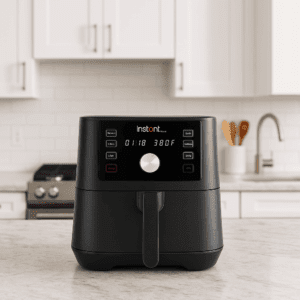
The Instant Pot Vortex 6QT XL Air Fryer sits in the most competitive size category on the market.
Not too small.
Not oversized.
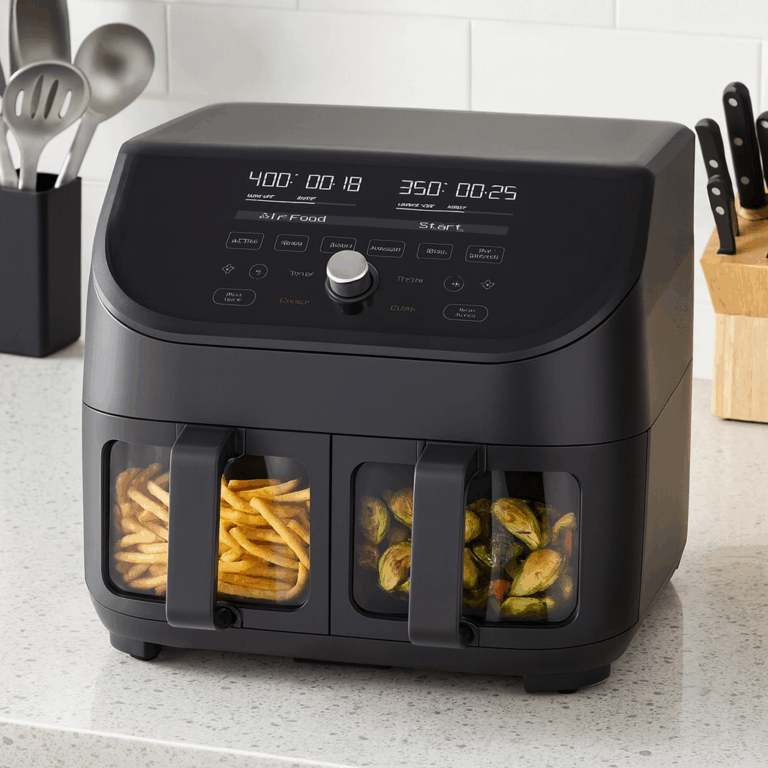
Not dual-basket complicated.
Six quarts is often marketed as the “family size.” But that label alone does not answer the real question.
Is this the right capacity for your routine, or should you go smaller or larger?
This review breaks that down clearly so you can decide without second-guessing.
If you want a broader context before committing, explore our complete air fryer reviews and buyer breakdown by kitchen size and cooking style to see how 6QT models compare across the category.
Verdict
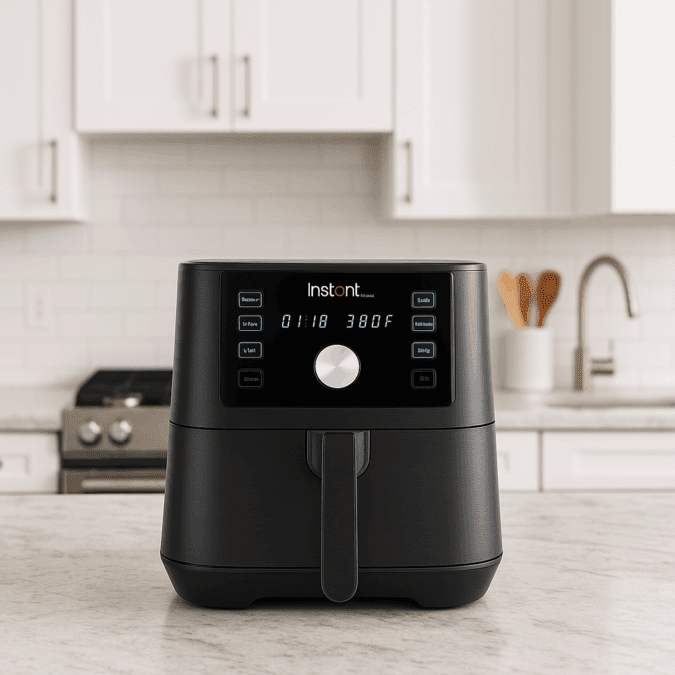
The Instant Pot Vortex 6QT XL is a strong mid-size option for households cooking three to four portions at a time. It balances counter footprint with real dinner capacity better than most compact models.
It is not ideal for large batch meal prep or dual-dish coordination. It may also feel oversized for singles or couples.
If your dinners typically serve three to four people, this model fits naturally. If you cook for one or expect synchronized protein and sides, reassess before buying.
Table of Contents
Why 6QT Is the Most Contested Size Category
The 6QT range competes directly against both compact 4QT units and larger 8QT dual-basket systems.
A 4QT saves space but limits portions. An 8QT dual-basket changes workflow but increases size and noise.
Six quarts attempts to balance those tradeoffs. It gives enough room for full proteins while avoiding the bulk of larger systems.
The key is whether your meals consistently require that middle ground.
What Fits Inside a 6QT Basket in Real Life
Capacity claims often lack context.
A 6QT basket comfortably holds:
- 3 to 4 chicken breasts
- 12 to 14 wings
- 1.5 pounds of fries
- A medium pork tenderloin
For a family of four, that often covers a main protein without overcrowding.
However, it still cannot cook two different dishes simultaneously at separate temperatures. That requires a dual-zone model.
If your typical dinner includes protein and vegetables cooked together, this size may still require sequencing.
When 6QT Is the Perfect Middle Ground
Six quarts exist because many households outgrow compact 4QT models but do not need dual-basket complexity. It provides enough room for full proteins without committing to oversized counter space.
For families of three to four, this size reduces overcrowding and improves airflow consistency. It allows larger portions without forcing constant batching.
At the same time, it avoids the bulk and noise of larger 8QT systems. For many kitchens, this balance feels intentional rather than excessive.
If your dinners revolve around one main category at a time, 6QT often becomes the practical middle ground between “too small” and “too much.”
Real Dinner Simulation: Weeknight Family Test
Let’s simulate a practical meal.
Four chicken thighs and seasoned potatoes.
Prep time: 7 minutes.
Temperature: 400°F.
Cook time: 22 minutes with one mid-cycle shake.
Total time, including short preheat, is roughly 25 minutes.
In a conventional oven, preheating alone can take 12 to 15 minutes. Cook time adds another 30 minutes. Total approaches 45 minutes.
The Vortex cuts that nearly in half while reducing kitchen heat significantly.
Where it differs from dual-basket models is in coordination. Vegetables may need to be cooked before or after the protein unless combined carefully.
Can It Cook Protein and Sides Together?
This is the question most 6QT buyers ask after purchase.
Technically, yes, but with limitations. You can layer certain vegetables beneath protein if cook times align, but spacing becomes tighter and airflow slightly restricted.
For dishes that require different temperatures or significantly different cook times, sequencing is still necessary. That means one item finishes before the other.
If finishing protein and vegetables at the same moment matters every night, a dual-basket model changes workflow more dramatically. If you are comfortable cooking in stages, 6QT remains manageable.
Understanding this distinction prevents unrealistic expectations.
EvenCrisp Technology: Marketing or Meaningful?
EvenCrisp circulates hot air from top to bottom for consistent browning.
In practice, results are reliable when food is spaced properly. Wings crisp evenly. Fries brown consistently with a single shake.
Overcrowding still reduces performance. No airflow system overrides physics.
EvenCrisp performs well within proper portion spacing. It does not eliminate the need for mid-cycle interaction.
Speed and Efficiency Compared to a Conventional Oven
The Vortex 6QT heats significantly faster than a traditional oven. Most ovens require 10 to 15 minutes of preheating before cooking even begins.
This model typically reaches cooking temperature within two to three minutes. That short ramp-up time reduces total meal duration noticeably on weeknights.
For proteins like chicken thighs or pork chops, cook times are often 20 to 25 minutes. Combined with faster preheating, dinner can finish 15 to 20 minutes sooner than oven preparation.
The smaller cooking chamber also reduces ambient kitchen heat. In warmer months, this difference becomes more noticeable than the time savings.
For large sheet pan meals or multi-tray baking, the oven remains more practical. For single-dish family dinners, the 6QT air fryer is generally faster and more efficient.
How Much Electricity Does a 6QT Air Fryer Actually Use?
Most 6QT air fryers, including the Vortex XL, operate around 1,500 to 1,700 watts. A conventional electric oven typically draws between 2,500 and 5,000 watts while heating a much larger cavity.
The difference is not just wattage. It is the size of the heated space. A 6QT air fryer concentrates heat in a small chamber, allowing it to reach cooking temperature faster and maintain it with less overall energy use.
For weeknight dinners serving three to four people, this often results in lower electricity consumption compared to preheating and running a full-size oven. Shorter cook times compound that efficiency advantage.
However, when preparing large sheet pan meals or multiple trays, the oven becomes more efficient per volume cooked. Heating a single large cavity once is more practical than running several air fryer cycles.
For small to mid-size meals, a 6QT air fryer is generally the more energy-conscious option. For large batch cooking, the oven still holds the advantage.
Why Airflow Matters More Than Basket Size
Capacity alone does not determine crisp results. Airflow discipline matters more.
The Vortex 6QT performs best when food sits in a single, even layer. Overcrowding restricts circulation and reduces browning consistency, even in larger baskets.
Many buyers assume upgrading in size automatically improves crispness. In reality, the spacing technique plays a bigger role than raw capacity.
Shaking fries midway, flipping proteins once, and avoiding stacked layers dramatically improve texture. When used correctly, 6QT provides strong airflow performance. When overfilled, results decline like any other air fryer.
Understanding this prevents frustration and protects long-term satisfaction.
Counter Space and Permanence
A 6QT model occupies noticeably more counter depth than compact 4QT units but remains smaller than dual-basket designs.
Most households leave it on the counter due to frequent use. It is movable, but not something you want to store daily.
If counter space is limited, measure first. Six quarts sit in the “semi-permanent” appliance category.
For apartment kitchens, this size may feel large. For suburban kitchens, it blends in comfortably.
Noise and Heat Under Load
At higher temperatures, the fan produces steady convection sound. It is audible but not harsh.
It is quieter than many dual-basket systems because it runs in a single chamber.
Heat output remains localized compared to an oven. This becomes noticeable in warmer climates.
If you value quieter operation, this size category is generally more tolerable than larger models.
How It Feels After 90 Days of Use
After three months, the Vortex typically becomes part of a routine rather than a novelty. It handles weeknight proteins, frozen foods, and reheating tasks consistently.
For many families, oven usage decreases noticeably for smaller dinners. The air fryer becomes the default option for meals that fit within its capacity.
The question that emerges over time is not performance but workflow. If cooking one dish at a time aligns with your habits, satisfaction remains high. If synchronized multi-dish cooking becomes important, limitations feel clearer.
Long-term contentment depends less on features and more on how closely your cooking pattern matches its single-basket design.
Cleaning and Long-Term Wear
The basket and tray feature a nonstick coating and are dishwasher safe.
With proper care, most owners can expect three to four years of consistent performance.
Metal utensils and aggressive scrubbing shorten coating life. Hand washing extends it.
Airflow performance remains stable when grease buildup is cleaned regularly.
This aligns with typical mid-tier air fryer durability expectations.
What Changes After 60 Days
During the first month, the Vortex often replaces oven use for most weeknight meals.
After two months, patterns stabilize. It becomes the primary appliance for proteins, frozen foods, and reheating crisp leftovers.
Large holiday meals still return to the oven. It does not fully replace full-capacity baking.
If cooking for four regularly, satisfaction remains high. If cooking for one or two, the basket may feel oversized for daily use.
Long-term value depends heavily on portion alignment.
6QT vs 4QT vs Dual Basket: Where This Fits
Compared to 4QT:
You gain real breathing room for proteins and reduce overcrowding.
Compared to the dual basket 8QT:
You lose synchronized cooking but save counter space and reduce complexity.
The 6QT works best when you cook single-category meals at moderate volume. If coordination matters more than space, dual basket models offer workflow advantages.
If you want practical meal inspiration tailored to this capacity, explore our family-sized air fryer recipes that fit a 6QT basket properly to see how full dinners perform without overcrowding.
Does It Replace Your Oven?
For small to mid-size dinners, often yes.
It preheats faster. It uses less electricity. It generates less ambient heat.
For casseroles, sheet pan meals, or baking multiple trays, the oven remains superior.
The Vortex reduces oven use but does not eliminate it.
Does 6QT Future-Proof Your Kitchen?
Six quarts provide room for moderate growth, but it is not limitless.
If children grow into teenage appetites or hosting becomes frequent, capacity may begin to feel tight. Larger gatherings still require oven support or multiple cycles.
For steady households of three to four people, a 6QT often remains sufficient for years. It balances usable space with a manageable footprint.
If you anticipate regular entertaining or significant household growth, evaluating 8QT or dual-zone models upfront may prevent upgrading later.
Future-proofing depends on how dynamic your household size is likely to become.
Cost Over Three Years
Used three to four times per week, this unit handles hundreds of meals annually.
Electricity savings compared to oven use for small portions add incremental value.
If you upgrade within a year because you need dual zones, the overall value decreases.
If your portion size aligns with 6QT long term, the cost-to-use ratio remains strong.
Sizing correctly prevents double-spending.
How It Compares to Other 6QT Air Fryers in This Range
Most 6QT models operate in a similar wattage range and temperature band. Performance differences often come down to airflow design, basket shape, and preset simplicity rather than raw power.
The Vortex stands out for consistent EvenCrisp browning and straightforward controls. It avoids unnecessary complexity while delivering reliable mid-size capacity.
Some competing 6QT models emphasize higher wattage or digital interface styling. Those differences rarely produce dramatic real-world cooking changes for single-dish meals.
Where dual-basket competitors separate themselves is workflow coordination, not crisp quality. If you want a broader overview of how mid-size and dual-zone units differ, explore our air fryer reviews and buyer comparison breakdown by size and cooking style to see the tradeoffs clearly.
The Vortex 6QT competes strongly within its size class. Its limitation is not performance but a single-basket design.
Who This Model Is Perfect For
Families of three to four.
Households cook one main dish at a time.
Buyers upgrading from 3QT or 4QT models.
Kitchens with moderate counter space.
Who Should Skip It
Singles cooking small portions.
Meal preppers are cooking large batch volumes.
Households want synchronized protein and sides.
Anyone with extremely limited counter depth.
What Buyers Ask Before Buying
Is 6QT big enough for a family of four?
Yes, for most single-dish meals. It may still require sequencing for multi-component dinners.
Is it too large for two people?
It can feel oversized for daily small portions, but it works well if you cook leftovers intentionally.
Does EvenCrisp make a noticeable difference?
It delivers consistent browning when food is spaced properly. It does not eliminate the need to shake or flip.
How loud is it?
Moderately audible but quieter than most dual-basket systems.
Is it worth upgrading from 4QT?
If you frequently overcrowd a 4QT basket, the added space is noticeable and worthwhile.
Who Quietly Regrets Choosing 6QT
Buyers who meal prep in bulk often find the 6QT limiting. Cooking multiple large portions in one session can require batching that offsets time savings.
Those who value synchronized cooking of protein and sides sometimes realize they wanted dual zones rather than a larger single space.
On the opposite end, singles or couples with limited counter space occasionally feel the footprint is larger than necessary for daily use.
Food quality rarely causes regret. Capacity alignment and workflow expectations do.
Choosing correctly depends on matching portion reality with long-term cooking habits.
Final Takeaway
The Instant Pot Vortex 6QT XL succeeds because it sits in the practical middle of the air fryer market.
It offers enough capacity for three to four portions without overwhelming your counter. It reduces oven use for weeknight meals while keeping operations simple.
If your dinners typically involve one main dish at a time and serve a small family, this is a confident buy.
If you need synchronized protein and sides or frequently cook in bulk, skip this and move toward an 8QT dual-zone model instead.
If you cook for one and value minimal footprint above all else, a 4QT may feel more efficient.
Choose it for balanced capacity and simplicity. Avoid it if your workflow demands coordination or large batch cooking.