The Ninja BN701 Professional Plus Blender makes the most sense for households that prepare smoothies, frozen drinks, and other pitcher-size recipes. Its main appeal is straightforward: a large container, three Auto-iQ programs, fixed manual speeds, and Ninja’s stacked blade assembly in a relatively simple package.
However, the BN701 is not a universal blender. It does not include personal cups, a food-processing bowl, or a variable-speed dial. Ninja also warns against processing hot ingredients in this type of pitcher. Buyers who need single servings, quiet operation, hot blending, or precise texture control should consider those limitations before choosing it.
This review is based on verified product specifications, Ninja’s documentation, replacement-part availability, and a comparison with similar Ninja models. It does not present research-based conclusions as personal hands-on testing.
If you are comparing multiple options, you can also browse our complete blender review breakdown to see how this model fits across performance categories.
(As an Amazon Associate, we earn from qualifying purchases.)
Quick Verdict: Is the Ninja BN701 Worth Buying?
The Ninja BN701 is worth considering if you want a full-size blender for large smoothies, crushed ice, frozen drinks, and repeat recipes. The 72-ounce pitcher has a 64-ounce maximum liquid capacity, giving it enough room for multiple servings without moving into a larger kitchen system.
Its three Auto-iQ programs, Smoothie, Ice Crush, and Ice Cream, automate the timing, pulsing, and pauses used for common frozen recipes. You can also use Low, Medium, High, and Pulse controls when an automatic program does not suit the recipe.
That combination makes the BN701 more flexible than its simple appearance suggests. You receive automatic convenience without losing all manual control.
The trade-offs are equally clear. The stacked blade assembly requires careful handling. The large pitcher is less convenient for small portions. There are no single-serve cups, and the fixed speeds do not offer the gradual control found on blenders with a variable-speed dial.
Best for
- Families and multi-person households
- Large smoothie or frozen-drink batches
- Buyers who want presets and basic manual controls
- People who do not need personal blending cups
- Buyers who prefer a pitcher-only system
Skip it if
- You primarily make one small smoothie
- You need a blender approved for hot liquids
- You want a variable-speed dial
- You prefer a compact or especially quiet appliance
- You want food-processing or dough attachments
Table of Contents
Ninja BN701 Specifications
| Feature | Ninja BN701 |
|---|---|
| Product name | Ninja Professional Plus Blender with Auto-iQ |
| Motor rating | 1,400 peak watts |
| Pitcher size | 72 ounces |
| Maximum liquid capacity | 64 ounces |
| Automatic programs | Smoothie, Ice Crush and Ice Cream |
| Manual controls | Low, Medium, High and Pulse |
| Blade system | Removable stacked Total Crushing blade assembly |
| Personal cups | Not included |
| Food-processing bowl | Not included |
| Hot-liquid blending | Not supported |
| Warranty | One-year limited warranty |
| Weight | Approximately 9.6 pounds |
Ninja’s published specifications and documentation should remain the controlling source for setup, operating limits, cleaning, and safety. You can verify the model through the official Ninja BN701 product page and the BN700-series owner’s guide.
What Auto-iQ Changes
Auto-iQ programs combine timed blending, pulsing, and pauses into one automatic cycle. The BN701 control panel includes three labeled programs: Smoothie, Ice Crush, and Ice Cream.
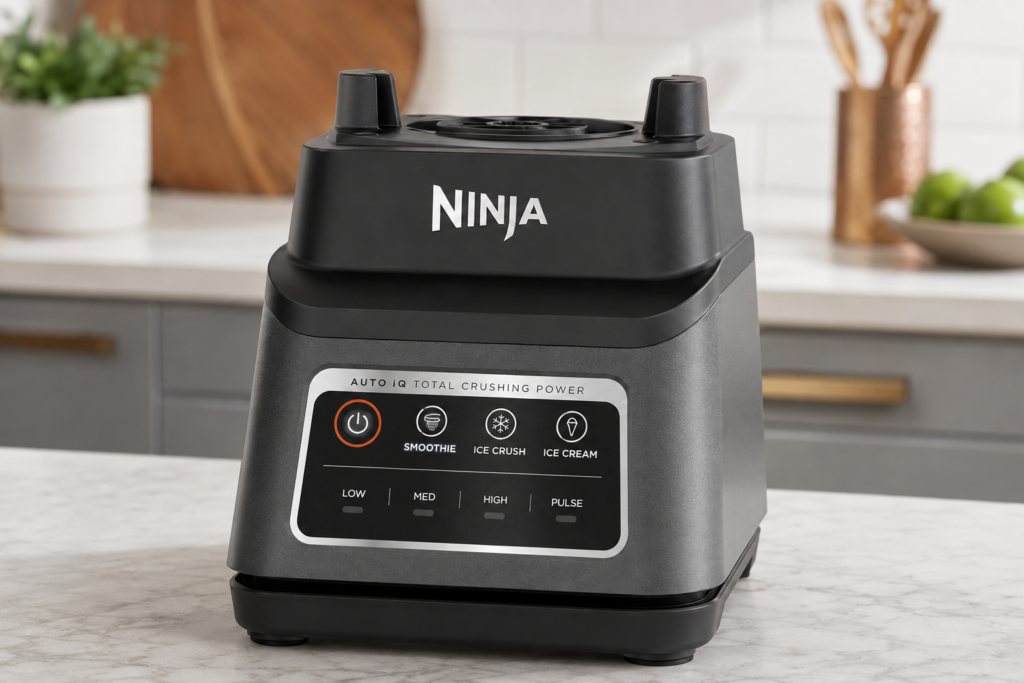
The Smoothie program is intended for blended fruit and drink recipes. Ice Crush targets ice and frozen ingredients used in frozen drinks. Ice Cream is designed for thicker frozen mixtures and dessert-style recipes.
Ninja’s product description sometimes describes the three preset uses more broadly as smoothies, frozen drinks, and nutrient extractions. However, shoppers looking at the physical BN701 control panel will see Smoothie, Ice Crush, and Ice Cream. Those are the clearest names to use when explaining the controls.
These programs can reduce the attention required by repeat recipes. You select the appropriate cycle instead of manually changing speeds and deciding when to pause or stop.
The blender cannot evaluate whether the ingredient ratio is correct. Too little liquid, an overloaded pitcher, or tightly packed frozen ingredients can still prevent proper circulation. Auto-iQ automates the cycle, but it cannot correct a poorly loaded container.
This distinction matters because the BN701’s convenience depends on the recipes you make. A household that regularly prepares smoothies, crushed-ice drinks, or frozen desserts may use the programs often. Someone who adjusts texture while preparing sauces, dressings, or delicate mixtures may prefer the manual controls.
The BN701 Has Manual Speeds, But Not a Variable Dial
The BN701 includes Low, Medium, High, and Pulse buttons. This corrects a significant error in the previous version of this review, which described the blender as lacking manual speed control.
What the BN701 lacks is a variable-speed dial that moves gradually across a wider range. Fixed speeds provide more control than presets alone, but they do not offer the fine adjustment available on many premium blenders.
Low can help begin a recipe without immediately using maximum power. Medium and High provide stronger processing as the mixture begins to circulate. Pulse gives short bursts for controlled chopping or repositioning ingredients.
This control panel should satisfy buyers who alternate between automatic programs and a few basic manual settings. It will feel limited to cooks who want to increase speed gradually or maintain a very specific texture.
What the Stacked Blade Design Means
Instead of placing one blade assembly only at the bottom of the pitcher, the BN701 uses a removable column with blades positioned at different heights. This design allows the blades to reach ingredients across more of the container.
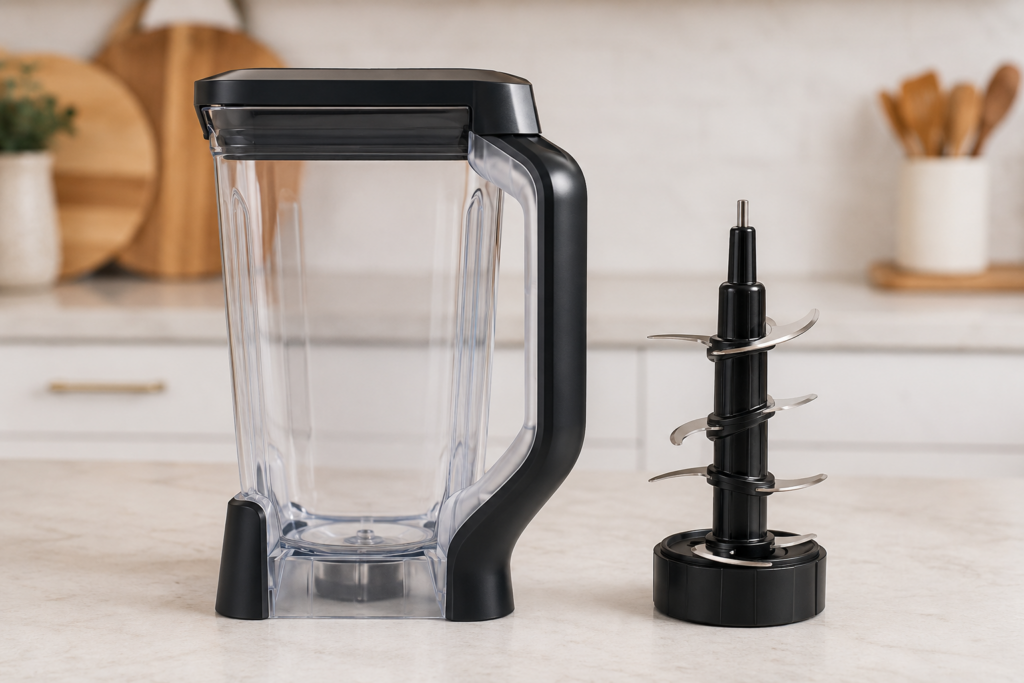
That arrangement suits large pitchers and ice-heavy recipes because ingredients do not all have to reach one small blade at the bottom. It also explains why the BN701 is oriented toward frozen drinks, smoothies, and larger batches.
The same design creates two compromises.
First, the tall blade assembly occupies space in the center of the pitcher. Removing thick mixtures from around it can take more effort than scraping a container with a bottom-mounted blade.
Second, the exposed blades require careful handling. Remove the assembly before pouring when Ninja’s instructions call for it, hold it by the top of the shaft, and avoid reaching into the pitcher around the blades.
The stacked blade system is not automatically superior to every bottom-blade design. It favors aggressive pitcher blending and ingredient contact over easy scraping and fine texture control.
Capacity: Large Batches Are the Real Advantage
Ninja describes the pitcher as 72 ounces, but the maximum liquid capacity is 64 ounces. Buyers should use the 64-ounce figure when planning drinks and other liquid recipes.
That capacity can reduce the number of cycles needed when preparing several servings. It also gives frozen ingredients room to move once the blades begin processing them.
The pitcher is less convincing for very small recipes. A small amount of food spread across a wide container may not circulate as effectively as it would in a personal cup or narrower jar. Using a large pitcher for one quick shake also creates more cleanup than necessary.
The BN701 therefore fits households that usually make several portions. If your normal recipe is one personal smoothie, buying the largest available container may solve a problem you do not have.
Recipes That Fit the BN701’s Design
The BN701 is best matched with recipes that benefit from a full-size pitcher and assertive blade contact. Likely uses include:
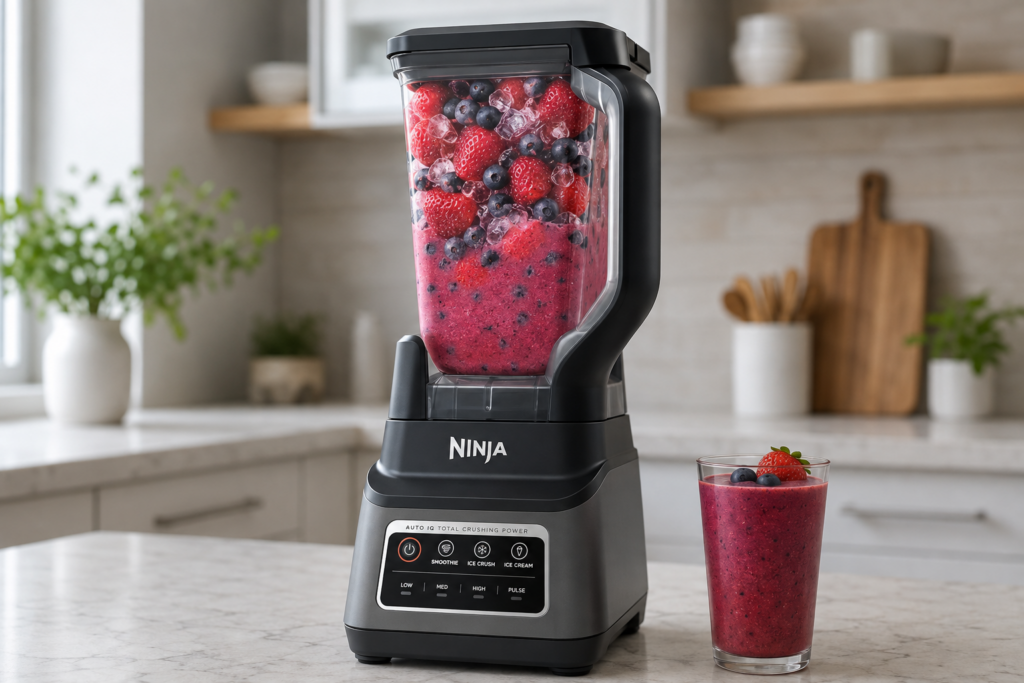
- Multi-serving fruit smoothies
- Protein shakes prepared for more than one person
- Frozen drinks and mocktails
- Crushed-ice recipes
- Milkshakes
- Smooth sauces made from cool ingredients
- Larger batches of dressings or marinades
Very thick recipes require more caution. Nut butter, low-liquid smoothie bowls, and frozen mixtures can resist circulation. These recipes may need smaller batches, additional liquid, pauses, or manual redistribution.
Do not use the BN701 as a hot-soup blender. Blend hot recipes only in appliances that the manufacturer specifically approves for that purpose.
BN701 Versus the Ninja BL610
The BL610 is a simpler pitcher blender. It uses a 72-ounce pitcher and stacked blade design but relies on manual controls instead of Auto-iQ programs.
That makes the choice fairly direct. Choose the BN701 when automatic cycles are worth paying for and you expect to use them. Choose the BL610 when you want a basic full-size Ninja and are comfortable controlling the speed and duration yourself.
The BN701 also carries a higher published peak-watt figure, but wattage alone should not decide the purchase. The more meaningful difference is workflow: preset automation versus a simpler manual interface.
Our Ninja BL610 review for batch drinks and ice-heavy recipes examines that model separately.
BN701 Versus the Ninja BN751
The BN751 Professional Plus DUO is the more versatile choice because it combines a large pitcher with two single-serve cups. That changes how the blender fits into a mixed household.
Choose the BN701 when nearly all your recipes belong in the full-size pitcher. Paying for single-serve cups provides little value if you will not use them.
Choose the BN751 when one person wants a travel smoothie while the household also needs batch capacity. The cups make smaller portions more practical and let users blend in the same container they take with them.
The BN751 costs more in many listings, although current prices can change. Compare the actual price difference at the time of purchase rather than assuming one model always costs a fixed amount.
You can review the pitcher-and-cup configuration in our Ninja BN751 evaluation for personal and family portions.
Cleaning and Storage Considerations
The removable pitcher, lid, and blade assembly reduce the number of hidden areas that need cleaning, but the blade column deserves special attention. Food can remain around the joints and beneath the lower blades if the assembly is only rinsed from above.
Rinsing immediately after use prevents many ingredients from drying onto the pitcher and blades. Follow Ninja’s dishwasher-placement instructions when using a dishwasher. Hand washing may be preferable when you want more control around the sharp assembly.
Storage can also affect the decision. The pitcher and lid add height to the motor base, so measure the clearance below your cabinets. If the assembled blender does not fit, you may need to store the pitcher separately.
The BN701’s pitcher-only configuration creates less accessory clutter than a kitchen system. However, it still occupies more space than a personal blender and is unlikely to disappear easily into a crowded cabinet.
Noise Expectations
Ninja does not publish a standardized operating-noise rating for the BN701. Without original measurements under controlled conditions, assigning it a precise noise score would be misleading.
It is reasonable to expect noticeable sound when a 1,400-peak-watt blender processes ice or frozen ingredients, but actual volume depends on the recipe, speed, counter surface, room, and distance from the machine.
If noise is a primary concern, do not assume that “Professional Plus” means quiet operation. Look for independently measured decibel comparisons performed under consistent conditions.
Replacement Parts and Ownership
Ninja sells compatible pitcher and blade components for the BN701, although availability and prices can change. The ability to replace a damaged pitcher, lid, or blade assembly can prevent one worn component from ending the useful life of the entire blender.
Confirm compatibility using the complete model number before ordering. Parts that look similar across Ninja blender families are not always interchangeable.
The included one-year limited warranty is relatively short compared with warranties offered on some premium blenders. Review what the warranty covers and retain your receipt. A higher initial price can be easier to justify when a blender includes longer coverage, but buyers must weigh that against how often they expect to use the machine.
Pros and Cons
Pros
- Large pitcher with a 64-ounce maximum liquid capacity
- Smoothie, Ice Crush, and Ice Cream Auto-iQ programs
- Low, Medium, High, and Pulse manual controls
- Stacked blade design suited to full-pitcher blending
- Replacement pitchers and blade assemblies are available
- Simpler storage than a multi-attachment kitchen system
Cons
- No personal blending cups
- No continuously adjustable variable-speed dial
- Not approved for hot-liquid blending
- Large pitcher is inefficient for some small recipes
- Stacked blades require careful handling
- Thick mixtures can be harder to remove around the blade column
- One-year limited warranty
Who Should Buy the Ninja BN701?
The BN701 suits a household that wants one straightforward pitcher blender for repeated smoothies, frozen drinks, ice-heavy recipes, and multiple servings. It is especially appealing when the Smoothie, Ice Crush, and Ice Cream programs will reduce the need to manage every cycle manually.
It also makes sense for buyers who want more control than presets alone provide. The fixed Low, Medium, High, and Pulse settings cover basic manual adjustments without making the control panel complicated.
Who Should Choose Something Else?
Choose another blender if you usually prepare one drink at a time. A personal blender or the BN751’s single-serve cups will fit that routine better.
A model with a variable-speed dial will suit buyers who want gradual control over sauces, textures, and more delicate recipes. A manufacturer-approved hot blender is necessary if hot soup is a central use. A kitchen system is more appropriate when food processing, chopping, or dough mixing matters as much as blending.
Final Verdict
The Ninja BN701 is a well-defined pitcher blender rather than an all-purpose kitchen system. Its strongest qualities are its large usable capacity, Smoothie, Ice Crush, and Ice Cream programs, fixed manual speeds, and stacked blade configuration.
Its limitations should drive the decision. It has no personal cups, no variable-speed dial, no hot-liquid capability, and no food-processing attachments. Those omissions keep the system simpler, but they also restrict who receives the best value.
Buy the BN701 if you regularly prepare multiple servings and want automatic cycles without giving up basic manual settings. Skip it if most of your recipes are small, hot, extremely thick, or dependent on precise speed adjustment.