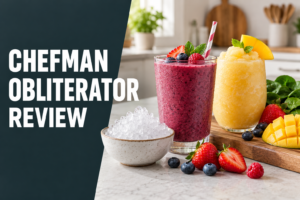
The Chefman Obliterator occupies an interesting position between basic countertop blenders and expensive high-performance machines. It offers a 1,380-watt motor, a 48-ounce pitcher, five manual speeds, and an Auto Blend setting that Chefman says adjusts its speed and running time based on the mixture’s consistency.
That combination targets people who want more control and capacity than a personal blender provides but do not want to pay premium-brand prices.
The Obliterator also includes features that are less common at its price point. These include an Ice Crush program, cleaning cycle, digital timer, overheating protection, tamper, and separate travel jar. However, the complete package takes more room than a basic blender, and its 48-ounce pitcher is smaller than the containers supplied with many full-size Ninja systems.
IMSolutionRealm did not physically test this blender. This review is based on Chefman’s product documentation, the RJ27-T1-TJ user guide, warranty information, retailer specifications, and recurring themes in publicly available owner feedback.
You can browse research on other countertop and personal blender designs if you are still deciding which format fits your kitchen.
(As an Amazon Associate, we earn from qualifying purchases.)
Table of Contents
Quick Verdict: Is the Chefman Obliterator Worth Buying?
The Chefman Obliterator is worth considering if you want a midsize pitcher blender with more control than an entry-level model.
Its five manual speeds let you manage texture, while Auto Blend offers a simpler option for common pitcher recipes. The Ice Crush program, Pulse control, and supplied tamper make the package more versatile than a blender designed only for liquid-heavy smoothies.
The 48-ounce pitcher is large enough for several drinks without becoming as bulky as a 72-ounce container. The separate 20-ounce travel jar also makes the system practical when you occasionally need one serving.
The most important limitation is that this is still a sizable countertop appliance with multiple accessories. Someone making only basic protein shakes may not use the larger pitcher, tamper, or automatic features enough to justify the space.
The Obliterator makes the most sense for a household that blends several times each week, regularly uses frozen ingredients, and wants both automatic and manual controls.
Chefman Obliterator Specifications
| Feature | Chefman Obliterator |
|---|---|
| Model series | RJ27-T1-TJ |
| Motor | 1,380 watts |
| Main container | 48-ounce blending jar |
| Personal container | 20-ounce travel jar |
| Manual speeds | Five |
| Additional control | Pulse |
| Programs | Auto Blend, Ice Crush and Clean |
| Display | Digital timer and warning indicators |
| Included tool | Two-in-one tamper and scraper |
| Hot ingredients | Permitted in main jar with stated precautions |
| Travel-jar restriction | Do not use with hot liquids |
| Cleaning | Jars and accessories listed as dishwasher safe |
| Warranty | Five-year limited warranty |
Chefman’s product page describes six speeds and three preset functions. The user manual provides the more precise explanation: five numbered manual speeds plus Pulse, with Auto Blend, Ice Crush, and Clean as preset functions.
That distinction is useful when comparing the Obliterator with another blender. Pulse is a momentary control rather than a sixth continuous speed.
Check the seller’s exact package before ordering. Some Obliterator listings may offer different colors or accessory combinations. The version discussed here includes the 48-ounce pitcher, 20-ounce travel jar, travel blade assembly, to-go lid, and tamper/scraper.
What Auto Blend Actually Does
Chefman says Auto Blend senses the consistency of food in the 48-ounce pitcher. The machine then selects a speed and running time for the mixture. The speed may change during the cycle, and the blender shuts off when the program ends.
This feature is designed to reduce manual decisions. Instead of choosing a speed and watching the timer, you select Auto Blend and allow the program to adjust the cycle.
However, Auto Blend cannot correct every recipe problem. Chefman’s manual states that very thick, sticky, or dry mixtures can trigger the Add Liquid indicator. The user may need to add liquid, operate the tamper, or stop and scrape the pitcher before continuing.
That warning makes the feature easier to understand. Auto Blend automates speed and timing, but it does not make loading order, ingredient size, or liquid quantity irrelevant.
The manual also says that Auto Blend was designed primarily for the 48-ounce pitcher. Although it can operate with the travel jar, Chefman recommends the manual speeds for better results in that smaller container.
This is one of the Obliterator’s more useful distinctions. Buyers get a simplified automatic option for pitcher recipes without giving up manual speed control.
Smoothies and Frozen Ingredients
The Obliterator’s specifications make it suitable for smoothies containing frozen fruit, leafy greens, yogurt, liquid, and protein powder. Its 48-ounce pitcher can prepare more than one serving, while the 20-ounce travel jar supports an individual drink.
Motor wattage alone cannot guarantee a perfectly smooth result. Ingredient size, liquid level, pitcher loading, and blending time still affect texture. Chefman recommends cutting solid foods into pieces of about one inch or smaller.
The Auto Blend program may suit routine pitcher smoothies because it controls the cycle automatically. The five manual speeds provide more flexibility when you want to start slowly, correct circulation, or stop at a coarser texture.
A standard drinkable smoothie should not require the tamper when the ingredients circulate properly. The tamper becomes useful when loose greens, larger ice pieces, or bulky ingredients remain above the blade path.
Very dense recipes can still require added liquid. Chefman specifically provides an Add Liquid warning for mixtures that create too much load or remain out of reach of the blades.
Ice Crushing and Frozen Drinks
The Obliterator has a dedicated Ice Crush program. Chefman says the program uses the machine’s dull-blade design and motor to reduce ice into a fine, snow-like texture.
The instruction manual recommends processing no more than 1½ pounds of ice at once. It also advises keeping the pitcher dry when crushing ice without liquid. Moisture can cause ice to stick to the bottom and process unevenly.
These details make the Ice Crush program useful for frozen cocktails, crushed-ice drinks, snow cones and similar recipes. However, buyers should not assume that a preset removes the need to observe the machine. Chefman advises stopping the program if all the ice has been crushed before the cycle ends.
The Pulse control provides another option when you want short bursts instead of a complete automatic program. Pulse can operate from standby or add extra power while using one of the five manual speeds.
If frozen drinks and ice are only occasional tasks, a simpler blender may be enough. The Obliterator becomes more appealing when these recipes are part of a regular routine.
Thick Mixtures and the Tamper
The supplied tool has two functions, but they must be used differently.
The tamper can pass through the opening in the pitcher lid while the blender runs. Chefman designed it so that it cannot reach the blades. It can push leafy greens, ice and bulky ingredients closer to the blade path.
The scraper side should only be used when the blender has stopped, and the blades are no longer moving. It helps remove hummus, batter, and other thick mixtures from the pitcher walls.
This separation is important for safe operation. The scraper is not an alternative tamper that can be inserted while the machine runs.
The Obliterator can work with some dense recipes, but it is not built around thick blending in the same way as the Ninja TWISTi. Its standard pitcher may still need extra liquid, tamping, or a pause for scraping.
For buyers who regularly make spoonable smoothie bowls with very little liquid, the specialized TWISTi design may be more convenient. The Chefman has the advantage when you want a more traditional pitcher, manual speeds, and broader general-purpose control.
The 48-Ounce Pitcher
The 48-ounce pitcher provides a useful middle size. It is larger than a personal blending cup but smaller than the 64- to 72-ounce containers supplied with many family-oriented systems.
This capacity can suit couples, smaller households or users who make a few servings at once. The pitcher should also be easier to handle and store than an oversized container.
Do not fill it past the marked 48-ounce maximum. Ingredients can rise during blending and cause an overfilled pitcher to leak or overflow.
The jar uses a two-piece lid with a removable center cap. The opening allows you to add liquid or insert the supplied tamper. When using higher speeds, Chefman advises keeping the measuring cap in place unless you are following the manual’s separate instructions for hot food.
The blades in the primary pitcher are not removable. This reduces the number of pieces that must be assembled, but it also means the user must clean around the fixed blade area carefully.
The 20-Ounce Travel Jar
The travel jar allows ingredients to be blended directly in a smaller container. After blending, you remove the blade assembly and install the to-go lid.
This can make the Obliterator practical for someone who alternates between shared pitcher recipes and individual morning drinks.
The travel jar has several important restrictions. It is not vented and must not be used with hot liquids. Chefman also advises against processing only ice without liquid in this container.
Auto Blend can operate with the travel jar, but Chefman recommends using the five manual speeds for better results. That means the travel jar should not be treated as a smaller version of the full pitcher with identical program behavior.
Confirm that the travel jar, blade assembly, and to-go lid appear in the exact retailer package you select.
Manual Speeds, Pulse and Timer
The Obliterator gives users five continuous manual speeds. Lower settings can begin a recipe gently, while higher settings support smoother textures and more demanding ingredients.
When a manual speed is selected, the digital timer counts upward. You can stop the blender at the desired point, or the machine will eventually reach its automatic manual-mode time limit.
Pulse provides short, controlled bursts. It can be pressed from standby or while a manual speed runs. When released during manual operation, the machine returns to the selected speed.
Pulse does not work during Auto Blend, Ice Crush or Clean programs.
This control layout provides a better balance than a blender that offers only preset buttons. Users can choose convenience for routine recipes or take direct control when texture matters.
The Fix Jar indicator warns when the container is not seated correctly. The Add Liquid indicator appears when the mixture creates too much load. These warnings can make troubleshooting easier than relying only on changes in motor sound.
Can the Chefman Obliterator Blend Hot Food?
The 48-ounce pitcher can process hot food, but only with Chefman’s specific safety precautions.
The manufacturer instructs users to let hot food cool slightly and fill only half the pitcher. Start at a low speed before increasing it. Remove the center measuring cap so steam can escape and cover the opening with a kitchen towel held securely in place.
Stop if pressure appears to build inside the container.
The 20-ounce travel jar must never be used with hot liquids because it is not vented.
This is an area where the old article needed more detail. Simply labeling the blender as supporting hot ingredients does not communicate the difference between the vented main pitcher and sealed travel container.
Anyone who plans to make soup should read the manufacturer’s instructions before attempting it. The blender does not contain a heating element. Ingredients must be cooked separately before blending.
Cleaning and Routine Maintenance
The Clean program provides a simple way to wash the main pitcher after ordinary recipes. Chefman recommends filling the pitcher one-quarter full with water, adding a few drops of mild dish soap and running the cleaning cycle.
The program can also clean the travel jar. Both jars and the other removable accessories are listed as dishwasher safe.
The fixed pitcher blades cannot be removed from the jar. Rinse the container soon after making thick dips, batters or smoothies so residue does not dry around the blade area.
The motor base should only be wiped with a damp cloth. Never place the base, cord or plug in water.
Chefman also advises against leaving the jars submerged for extended periods or using steel wool and abrasive cleaning materials. These can damage the surfaces.
For broader ownership advice, see our routine care for blender pitchers and blade assemblies.
Overheating Protection and Heavy Recipes
The Obliterator includes motor-overheat protection. If the blender becomes too hot during a demanding or extended task, the display shows “Hot” and prevents further blending until the motor cools.
Chefman’s troubleshooting instructions say cooling can take about 20 minutes.
This protection may prevent continued operation under excessive heat, but it should not be treated as permission to overload the blender. Dense ingredients, insufficient liquid, and excessively long cycles still place added stress on the motor.
If the Add Liquid indicator appears, stop and correct the mixture. Use the tamper where appropriate, add liquid or scrape the pitcher after the blades stop.
Frequent overheating indicates that the recipe, batch size, or operating method may not suit the machine.
Noise, Counter Space and Storage
Chefman promotes an advanced airflow system intended to keep the motor cooler and quieter. That does not make the Obliterator a silent appliance.
The company’s own manual notes that Auto Blend can use loud, high-speed pulsing when processing dense mixtures. Ice crushing will also produce more noise than blending soft fruit with liquid.
Noise-sensitive buyers should not choose this model solely because of the airflow claim. Its actual sound will vary with the ingredients, speed and surface beneath the motor base.
The 48-ounce pitcher is less bulky than some full-size containers, but the motor base, pitcher, travel jar, separate blade assembly, lids, and tamper still require storage.
Measure the assembled height and cabinet clearance before ordering. Also decide where the travel blade and tamper will be kept so they do not become misplaced accessories.
Five-Year Limited Warranty
Chefman provides a five-year limited warranty for the RJ27-T1-TJ series when purchased from an authorized distributor or retailer.
The warranty applies to the original purchaser and requires proof of purchase. It covers defects in materials and workmanship under normal household use.
It does not cover misuse, poor maintenance, commercial use, ordinary wear, unauthorized alterations or damage from catastrophic events.
A five-year term is notable in this category, but the conditions still matter. Keep the receipt, record the exact model number, and consider registering the product with Chefman.
The warranty should not be interpreted as a promise that every worn component will receive free replacement. Normal wear and damage caused by misuse are specifically excluded.
Who Should Buy the Chefman Obliterator?
The Obliterator makes the most sense for:
- Couples and smaller households using a blender regularly
- Buyers moving beyond a basic countertop blender
- People preparing smoothies and frozen drinks several times per week
- Users who want both presets and manual speed control
- Households that will use a midsize pitcher and personal travel jar
- Buyers who value a five-year limited warranty
It is less suitable for:
- People who only make an occasional protein shake
- Large families needing a 64- or 72-ounce pitcher
- Buyers with very limited storage space
- Users expecting nearly silent ice crushing
- People who primarily make extremely thick smoothie bowls
- Anyone wanting a food processor or dough-making system
The value depends on whether you will use its range of controls. If you only need one drink at a time, the larger base, pitcher, and accessories may add more complexity than benefit.
Chefman Obliterator Versus a Basic Blender
A basic blender may be enough for soft fruit, protein powder, and liquid-heavy recipes. It may also occupy less counter space and cost substantially less.
The Obliterator adds five manual speeds, Pulse, Auto Blend, Ice Crush, Clean, warning indicators, a timer, and a tamper. These features provide more control and can reduce guesswork with frozen ingredients.
However, those additions only provide value when used. An automatic program will not matter much to someone who blends once a week, and the travel jar does not help someone who always prepares shared batches.
The better reason to choose the Chefman is not the product name or wattage number. It is the combination of a manageable 48-ounce pitcher, separate personal jar, and both manual and automatic operation.
Before deciding, compare pitcher capacities and control styles across current blender types.
Pros and Cons
Pros
- Five manual speeds plus Pulse
- Auto Blend, Ice Crush and Clean programs
- Manageable 48-ounce pitcher
- Separate 20-ounce travel jar
- Tamper and scraper included
- Digital timer and warning indicators
- Five-year limited warranty
- Main pitcher can process hot food when instructions are followed
Cons
- Complete package requires meaningful storage
- Travel jar cannot process hot liquids
- Auto Blend works best with the main pitcher
- Dense recipes may still require more liquid or scraping
- Fixed pitcher blades cannot be removed
- High-speed and ice-crushing cycles will still create noise
- Smaller capacity than family-size blender systems
Final Verdict
The Chefman Obliterator is a well-equipped midsize blender for buyers who want more control than a basic model provides.
Its strongest feature is the combination of five manual speeds and Auto Blend. You can automate a routine pitcher recipe or control the texture yourself. The 48-ounce container also avoids some of the bulk associated with oversized family pitchers.
The Ice Crush program, travel jar, cleaning cycle, tamper, and five-year limited warranty strengthen the overall package. At the same time, these accessories take storage space, and Auto Blend cannot rescue every overloaded or low-liquid recipe.
The Obliterator is most useful for a smaller household that prepares smoothies, frozen drinks, dips, and similar recipes several times each week. A personal blender is simpler for individual shakes, while a larger system makes more sense for family batches and food processing.