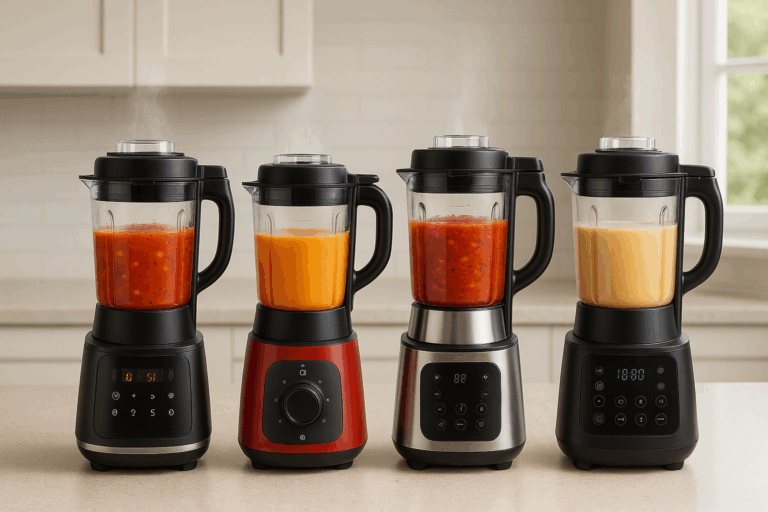
The Vitamix 5200 is the best blender for heavy daily use for most homes. Its simple controls, tall 64-ounce container, tamper, and seven-year warranty suit people who care more about dependable blending than presets or a touchscreen.
The 5200 is not the right answer for everyone. Choose the Vitamix Propel 750 if you want a shorter container and automatic programs. The Ascent X5 adds the most guided automation. The Blendtec Professional 800 is the strongest choice when noise matters. Breville’s Super Q offers a flexible two-container workflow, while the Vitamix VX1 is the value pick for shoppers who want the classic tall-container format at a lower entry price.
Important: Every model in this guide is intended for demanding household use. A residential blender used in a cafe, restaurant, catering operation, or other business may lose its warranty coverage. Buy a commercial-rated model for commercial work.
Table of Contents
Best Heavy-Use Blenders at a Glance
| Blender | Best For | Main Container | Controls | Household Warranty | Main Drawback |
|---|---|---|---|---|---|
| Vitamix 5200 | Best overall | 64 oz, tall | Variable dial, High, pulse-style on/off control | 7 years | Too tall for many cabinets |
| Vitamix Propel 750 | Repeated family-size batches | 64 oz, low profile | Variable dial, pulse, 4 programs | 7 years | Wide jar favors medium or large loads |
| Vitamix Ascent X5 | Best premium automation | 48 oz | Variable dial, pulse, 10 programs | 10 years | High price for features, not a basic performance need |
| Blendtec Professional 800 | Best quiet option | 90 oz jar, lower usable blending capacity | Touch controls and programs | 10 years | Large, expensive enclosure |
| Breville Super Q | Best multi-user workflow | 68 oz plus personal cup | 12 speeds and 5 programs | Check current regional terms | More parts and controls to manage |
| Vitamix VX1 | Best value | 64 oz, tall | 10 speeds and pulse | 5 years | Fewer convenience features |
Capacity labels do not tell you the safe working capacity for every recipe. Hot liquids, thick mixtures, and aerating recipes may require smaller loads. Follow the model’s manual.
What “Heavy Daily Use” Means in a Home Kitchen
A blender that makes one soft-fruit smoothie each morning does not face the same workload as a machine that handles frozen fruit at breakfast, hummus at lunch, and soup or sauce at dinner. For this guide, heavy daily use means several household batches on many days of the week, including a mix of demanding ingredients.
That workload can include frozen fruit, fibrous greens, ice, thick dips, nut butter, large family batches, and back-to-back recipes. It also makes details such as airflow, overload protection, jar geometry, tamper access, cleanup time, and control simplicity more important.
Motor wattage alone does not determine which blender will hold up best. A high number on a product page says little about cooling, torque under load, container flow, coupling design, or how easily a user can prevent a thick mixture from stalling. We gave more weight to the complete blending system and the warranty behind it.
How we chose these Blenders
We compared each model across six factors:
- Repeated-batch workflow: The controls, container, lid, tamper, and cleaning process should remain practical after more than one blend.
- Container flow: A good jar must pull ingredients toward the blades instead of leaving users to stop and scrape constantly.
- Control under load: Variable speed and pulse functions help users start thick recipes gently and correct the texture before a mixture overheats.
- Recipe range: A heavy-use machine should cover more than smoothies. We looked for credible versatility with soups, sauces, frozen mixtures, dips, and dense recipes.
- Warranty and support: Longer household coverage does not prove that a machine will last, but it reduces the buyer’s risk and shows what the manufacturer is prepared to support.
- Value for the intended user: Extra programs, sound enclosures, and connected features only improve a ranking when they solve a real workflow problem.
We did not rank models by advertised horsepower or wattage alone. We also did not treat “commercial-grade” marketing language as permission for commercial use.
Heavy daily use is only one reason to choose a particular machine. If durability is not your only priority, you can also compare our best blenders by use case before deciding which features deserve your money.
1. Vitamix 5200 – Best overall
The Vitamix 5200 remains the most sensible heavy-use recommendation because it combines a proven layout with very little operational clutter. It has a tall 64-ounce container, a variable-speed dial, a High setting, and a tamper for keeping thick mixtures moving. There is no touchscreen to learn and no preset required to get a good result.
The tall container is a major part of the appeal. Its narrow lower section can form an effective vortex with smaller and medium-size recipes, yet the jar still has enough room for larger household batches. That range matters when one machine must make a single smoothie in the morning and soup for several people later.
Manual control also fits heavy use better than it may appear. The user can begin at a low speed, increase power as the ingredients start moving, and use the tamper before an air pocket turns into a stall. Presets are convenient, but they cannot read every variation in frozen-fruit ratio, liquid level, or ingredient temperature.
The tradeoff is physical size. The assembled 5200 is tall, so it often will not fit beneath upper cabinets. It is also loud and lacks automatic programs. Those are genuine inconveniences, but neither weakens its core ability to handle varied daily work.
Pros
- Tall 64-ounce jar works across a useful range of batch sizes
- Simple controls are easy to adjust during demanding recipes
- Included tamper helps with thick and frozen mixtures
- Seven-year household warranty covers more than many mainstream alternatives
- Straightforward design avoids paying for automation you may not use
Cons
- Tall profile can create storage problems
- No automatic blending programs
- Loud at high speed
Best for: Households that blend several times a day and want one durable, versatile machine without premium electronics.
Our take: Buy the 5200 when blending performance, batch flexibility, and direct control matter more than counter height or one-touch convenience.
For a closer look at its blending performance, container design, controls, noise, and long-term value, read our complete Vitamix 5200 review.
2. Vitamix Propel 750 – Best for repeated family-size batches
The Propel 750 is a better fit than the 5200 when most recipes are medium or large and the blender must live under a cabinet. Its low-profile 64-ounce container spreads the ingredients over a wider blade area and keeps the assembled height more manageable.
Four programs automate common tasks, while the variable-speed dial and pulse control remain available when a recipe needs manual correction. That combination helps in a busy household. One person can use a program for a routine smoothie, while another can control the texture of salsa, soup, or a thick dip.
The wide container is less convincing for very small batches. Small amounts can spread across the broad base instead of circulating as efficiently as they would in the 5200’s narrow container. Buyers who often make single servings should plan on an additional compatible container or choose a model better suited to low volumes.
Pros
- Low-profile 64-ounce jar suits family-size recipes
- Four programs reduce supervision for repeat tasks
- Variable speed and pulse preserve manual control
- Seven-year household warranty
- Easier to place under cabinets than the 5200
Cons
- Wide jar is not ideal for every small recipe
- Costs more than simpler models
- Still loud enough to interrupt a nearby conversation
Best for: Families that prepare large smoothies, soups, frozen drinks, or meal-prep recipes several times a day.
Our take: The Propel 750 earns its place through workflow, not higher raw power. It is the more convenient large-batch Vitamix when presets and cabinet clearance matter.
3. Vitamix Ascent X5 – Best premium automated blender
The Ascent X5 makes sense for a frequent user who wants more guidance and is willing to pay for it. It offers ten programs, a 48-ounce container, variable speed, pulse, and a ten-year household warranty. The programs cover a broader range of tasks than the simpler Vitamix models and can reduce the need to watch routine blends.
Its 48-ounce jar is a practical middle size. It gives up some family-batch capacity compared with a 64-ounce container, but it is less awkward for moderate recipes. The X5 also belongs to Vitamix’s current self-detecting container system, which can appeal to buyers planning a broader set of compatible attachments.
The X5 does not automatically make a smoothie several hundred dollars better than one from the 5200. Its value comes from convenience, a longer warranty, guided programs, and ecosystem flexibility. A buyer who normally turns a dial and watches the texture can save money without sacrificing the essential blending job.
Pros
- Ten programs support a varied daily routine
- Ten-year household warranty
- 48-ounce jar handles moderate batches well
- Manual speed and pulse controls remain available
- Strong choice for users invested in compatible Vitamix containers
Cons
- Premium price
- Smaller main jar than the 64-ounce picks
- Added automation may be unnecessary for confident users
Best for: Frequent home users who value one-touch consistency, guided functions, and long warranty coverage.
Our take: The X5 is the feature winner, not the automatic value winner. Choose it because you will use its programs and container ecosystem.
4. Blendtec Professional 800 – Best quiet blender for heavy use
Noise becomes a serious buying factor when a blender runs several times a day in an open kitchen, early in the morning, or near a home office. The Blendtec Professional 800 addresses that problem with a sound enclosure around the jar rather than relying only on motor tuning.
Its programmed cycles and touch controls make repeat recipes easy to hand off between household members. The jar also uses Blendtec’s blunt-blade design and does not depend on a traditional tamper for ordinary blends. The ten-year household warranty is reassuring at this price.
The enclosure is the reason to buy the Professional 800, but it is also the main compromise. It consumes significant counter space and raises the price well beyond many high-performance blenders. Thick mixtures may also require a different technique than tamper-driven Vitamix recipes. No high-powered blender is silent; the enclosure simply makes this model much easier to live with.
Pros
- Sound enclosure reduces the disruption of frequent blending
- Programmed cycles create a repeatable workflow
- Ten-year household warranty
- Large jar supports bigger recipes
- Easy-to-clean touch interface
Cons
- Expensive
- Bulky on the counter
- Residential warranty is void for commercial use
Best for: Open-plan homes, early risers, shared kitchens, and anyone who blends often enough for noise to affect the household.
Our take: Pay the premium only if sound reduction has real daily value. Otherwise, a less expensive high-performance machine is the stronger buy.
5. Breville Super Q – Best for a flexible multi-user workflow
The Breville Super Q pairs a large 68-ounce jug with a personal blending cup and dedicated blade system. That two-container setup is useful when several people use the same machine. A family can prepare a large batch, then make an individual drink without dirtying the full-size jug again.
Five one-touch programs and 12 speed settings give the Super Q a broad working range. Breville also designs the base to recognize the attached vessel and adjust its operation. This makes the system approachable for users who do not want to manage every blend manually.
The drawback is complexity. More containers, blades, seals, and programmed controls create more pieces to wash and track. Regional warranty terms also deserve close attention before purchase. Buyers should confirm the current coverage on the exact product page rather than assume it matches the longer warranties offered by some competitors.
Pros
- Includes full-size and personal blending formats
- Five programs and 12 speeds
- Vessel recognition simplifies switching containers
- Large jug works for household meal preparation
- Good fit when several people share one base
Cons
- More parts to clean and store
- Warranty terms may be less compelling than leading rivals
- Wide feature set adds cost and complexity
Best for: Busy households that alternate between individual drinks and large recipes throughout the day.
Our take: The Super Q is compelling when both included containers will be used. If you only want a full-size jar, simpler machines offer better long-term value.
6. Vitamix VX1 – Best value for heavy daily use
The VX1 is the budget-minded route into the classic Vitamix format. It uses a tall 64-ounce container and offers ten speeds plus pulse control. That gives it the same basic workflow advantages that make the 5200 appealing: a narrow jar, direct control, and enough room for larger household batches.
Its five-year limited warranty is shorter than the coverage on the 5200, Propel 750, or Ascent X5. The controls and package are also less premium. Those compromises are acceptable when the price difference is meaningful, and the buyer wants performance fundamentals instead of presets.
The VX1 is not a bargain if it sells close to the 5200. Compare current prices and warranty terms on the day of purchase. If the gap is small, the 5200’s longer coverage and established track record make it the safer choice.
Pros
- Tall 64-ounce container supports varied batch sizes
- Ten speeds and pulse provide direct texture control
- Lower entry price than premium Vitamix models
- Simple interface suits repeated use
- Strong alternative to cheaper short-warranty blenders
Cons
- Five-year warranty is shorter than other Vitamix picks
- No automatic programs
- Value depends heavily on the current price gap
Best for: Frequent users who want a full-size Vitamix but do not need presets or premium finishes.
Our take: The VX1 is the value winner only when it is clearly cheaper than the 5200. Always compare the final prices before deciding.
Which heavy-use blender should you buy?
Choose by the part of the daily workflow that creates the most friction.
- Buy the Vitamix 5200 for the best balance of control, batch flexibility, warranty coverage, and simplicity.
- Buy the Vitamix Propel 750 for frequent family-size batches and automatic programs in a shorter design.
- Buy the Vitamix Ascent X5 when guided programs, a 10-year warranty, and compatible accessories justify the premium.
- Buy the Blendtec Professional 800 when reducing noise matters more than counter space or price.
- Buy the Breville Super Q when the same base must serve both large recipes and personal drinks.
- Buy the Vitamix VX1 when it provides a meaningful discount from the 5200.
For most households, the 5200 remains the clearest answer. It does not try to automate every task. Instead, it gives frequent users a strong motor base, an adaptable jar, and enough control to respond when a difficult recipe needs more liquid, a slower start, or help from the tamper.
What matters most in a blender used several times a day
Container shape matters as much as capacity
A 64-ounce label does not guarantee good results with every volume. Tall, narrow jars tend to keep smaller quantities closer to the blades. Wide low-profile jars make large loads easier to manage and fit beneath cabinets, but they may need more ingredients to circulate properly.
Match the jar to the batch you make most often. Buying the biggest number can leave a single-person household with a container poorly suited to its routine.
A tamper can prevent unnecessary strain
Frozen desserts, nut butter, hummus, and other thick mixtures can form an air pocket around the blades. A lid-compatible tamper moves food back into circulation while the blender runs. That is safer and faster than repeatedly stopping to scrape, provided the user follows the manual.
Cooling breaks still matter
Overload protection helps prevent damage, but it is not a license to run endless back-to-back cycles. If the base smells unusually hot, slows down, or shuts itself off, stop and follow the manufacturer’s cooling instructions. Repeatedly restarting an overheated blender works against the durability you paid for.
Replacement containers affect long-term value
Heavy use wears lids, seals, bearings, and jars faster than occasional use. Before buying, check the price and availability of the complete replacement container, not only small accessories. A blender with accessible parts can be a better long-term purchase than a cheaper model that becomes difficult to maintain.
Long-term ownership is easier when jars, lids, and other components remain available, so compare our blenders with easy-to-find replacement parts before buying.
Household and commercial use are different categories
Preparing several meals a day at home can fit a residential machine’s intended use. Making paid orders, serving customers, or running the blender in a workplace may not. Vitamix and Blendtec both limit the residential warranties cited here to household use. Commercial buyers should compare duty cycle, service access, sound requirements, and commercial warranty terms instead.
Frequently asked questions
How many times a day can you use a high-performance blender?
There is no universal safe number. Recipe thickness, cycle length, ingredient temperature, load size, ventilation, and rest time all affect strain. Follow the manual, keep the base’s vents clear, and allow the motor to cool if it becomes unusually hot or activates overload protection.
Is the Vitamix 5200 better than the Propel 750 for daily use?
The 5200 is better for varied batch sizes and users who prefer direct control. The Propel 750 is better for larger batches, cabinet clearance, and automatic programs. Both carry a seven-year household warranty according to Vitamix’s current product information.
Are Ninja blenders good for heavy daily use?
Some full-size Ninja systems offer strong ice crushing and useful accessories at a lower price. They can be good value for ordinary daily smoothies. For several demanding batches every day, however, jar flow, thick-mixture control, warranty length, replacement-part access, and motor cooling deserve more weight than peak wattage. That is why no Ninja model outranked the six picks in this guide.
Is a more powerful motor always more durable?
No. Rated power does not reveal cooling efficiency, bearing quality, coupling design, jar flow, or how the machine responds to overloads. A well-matched motor, blade, container, controls, and protection system matter more than one headline number.
Can these blenders be used in a smoothie shop?
Not under the residential coverage discussed here. Buy a commercial-rated blender with warranty terms that explicitly cover the business and expected workload.