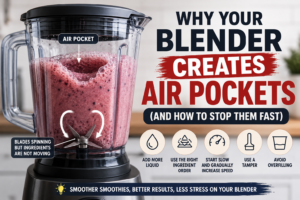
If your blender sounds like it is running normally, but the ingredients stop moving, you are probably dealing with an air pocket.
This is one of the most common smoothie blending problems people experience with frozen fruit, protein shakes, nut butters, and thick recipes.
The blades spin, but the ingredients stop circulating properly. This creates chunky smoothies, uneven texture, overheating, and unnecessary strain on the motor.
The good news is that blender air pockets are usually easy to fix once you understand why they happen.
Table of Contents
Quick Fix for Blender Air Pockets
If your blender keeps creating air pockets, try these fixes first:
- Add more liquid before blending
- Put liquids in first
- Reduce the amount of frozen ingredients
- Start on a lower speed
- Use a tamper if your blender supports one
- Stop and stir thick mixtures manually
- Avoid overpacking the jar
In many cases, changing the ingredient order solves the problem immediately.
What Is an Air Pocket in a Blender?
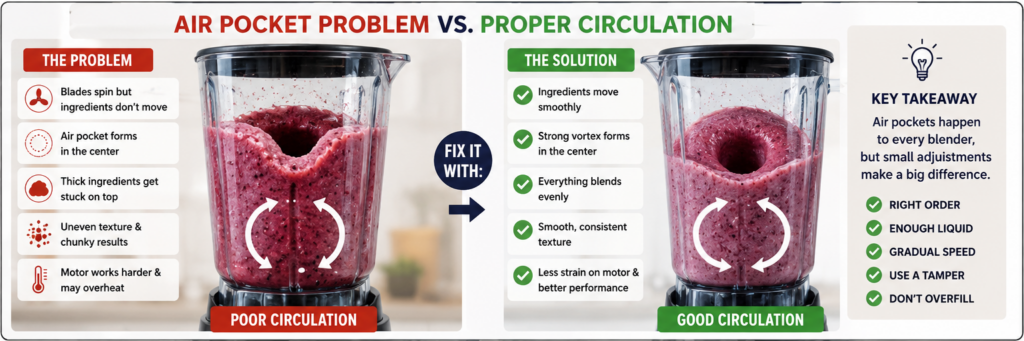
An air pocket happens when ingredients stop circulating around the blades.
Instead of creating a strong blending vortex, the blender traps empty space near the blades while thick ingredients stick above the spinning area.
This often causes:
- Loud spinning with no movement
- Thick mixtures sitting at the top
- Frozen fruit refusing to blend
- Nut butters stalling
- Uneven smoothie texture
- Overheating
Air pockets happen most often with:
- Frozen fruit smoothies
- Protein shakes
- Thick smoothie bowls
- Ice-heavy drinks
- Peanut butter recipes
- Low-liquid mixtures
Why Blender Air Pockets Happen
Too Many Frozen Ingredients
This is the biggest cause.
Frozen strawberries, mango chunks, ice cubes, and frozen bananas can compact together and block circulation.
Frozen fruit also releases moisture slowly compared to fresh ingredients. That means the blender may not have enough free-flowing liquid near the blades during startup.
This creates a gap between the blades and ingredients.
If you regularly make frozen smoothies or thick blended drinks, these step-by-step blender troubleshooting guides for smoothie consistency and blending performance can help prevent common circulation problems.
Incorrect Ingredient Order
Ingredient order matters more than most people realize.
The best loading order is usually:
- Liquids
- Powders
- Soft ingredients
- Greens
- Frozen fruit
- Ice
Liquids near the blades help create immediate circulation.
If frozen ingredients sit at the bottom, they can block movement before the vortex forms.
Many people accidentally create air pockets by dumping frozen fruit into the blender first.
Not Enough Liquid
Thick smoothies need enough liquid to maintain circulation.
Even high-powered blenders struggle if the mixture becomes too dense.
Some ingredients absorb liquid quickly, including:
- Protein powder
- Chia seeds
- Oats
- Peanut butter
- Frozen bananas
If your smoothie thickens too fast, the vortex collapses, and trapped air forms near the blades.
A small increase in liquid often fixes the issue instantly.
Starting at Maximum Speed Immediately
Starting too fast can force ingredients against the walls before circulation begins.
This is especially common with:
- Personal blenders
- Narrow jars
- Thick smoothie recipes
A slower startup helps ingredients move toward the blades naturally before increasing speed.
Blender Jar Shape
Not all blender jars circulate ingredients equally.
Wide-bottom jars sometimes struggle more with thick recipes compared to narrow vortex-style containers.
Some lower-powered blenders also have blade designs that struggle with dense mixtures.
This becomes more noticeable during:
- Frozen fruit blending
- Ice crushing
- Nut butter recipes
- Thick smoothie bowls
If you are comparing machines for frozen fruit blending, thick smoothie performance, and smoother ingredient circulation, explore these best blender reviews for crushing ice, frozen fruit, and dense smoothie recipes.
Signs Your Blender Has an Air Pocket
You probably have an air pocket if:
- The blades spin freely, but the ingredients do not move
- The center becomes hollow
- Thick ingredients stick to the walls
- Smoothies stay chunky
- The blender suddenly gets louder
- You need to shake the jar repeatedly
Many people confuse air pockets with weak blender motors.
In reality, even powerful blenders can develop trapped air with improper loading or thick recipes.
How to Stop Blender Air Pockets
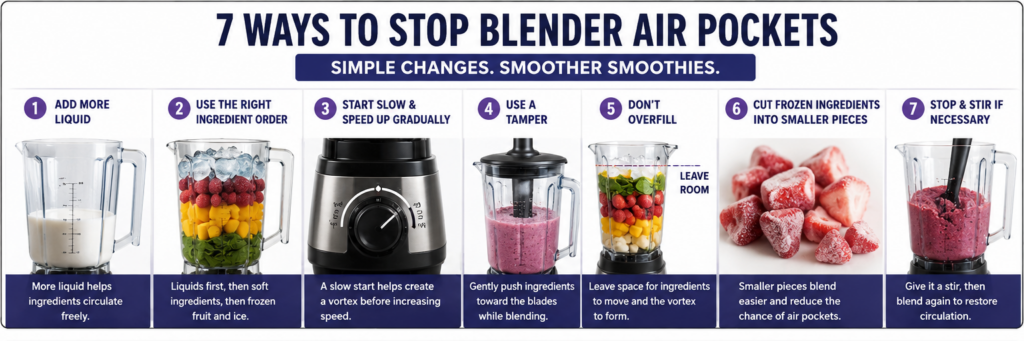
Add Liquid First
Always pour liquids into the blender before frozen ingredients.
Good options include:
- Water
- Milk
- Almond milk
- Coconut water
- Juice
- Yogurt
This helps the blades grab ingredients immediately.
Reduce Ice Quantity
Too much ice creates hard blockages.
Instead of adding large amounts of ice:
- Use frozen fruit
- Partially thaw ingredients
- Use smaller ice cubes
This improves circulation dramatically.
Blend in Stages
For thick mixtures:
- Start slow
- Increase speed gradually
- Pause if circulation stops
- Stir manually if needed
- Restart blending
This prevents the motor from fighting a dense frozen block all at once.
Use a Tamper Properly
If your blender includes a tamper, use it.
Tampers help push ingredients toward the blades safely during blending.
High-performance blenders like Vitamix models rely heavily on proper tamper technique for thick recipes.
Never use utensils inside a running blender.
Avoid Overfilling the Blender
Overpacked jars create poor circulation.
Leave enough room for ingredients to move freely.
A blender packed to the lid often traps ingredients above the blades.
This is extremely common in:
- Meal prep smoothies
- Protein shakes
- Frozen desserts
Best Ingredients for Smoother Blender Circulation
Some ingredients naturally improve blending flow.
Helpful additions include:
- Yogurt
- Banana
- Milk
- Avocado
- Coconut water
These create smoother movement compared to dense dry mixtures.
Common Blender Air Pocket Mistakes
Using Huge Frozen Fruit Chunks
Large frozen pieces are harder to circulate.
Smaller frozen fruit blends more evenly and reduces strain.
Adding Powders Too Early
Protein powder and supplements can thicken liquid near the blades.
This sometimes creates a paste-like buildup that blocks movement.
Ignoring the Blender’s Capacity
Personal blenders are not designed for huge frozen batches.
Trying to force oversized recipes often creates stalling and trapped air.
The Ninja BlendBoss is one example of a machine designed for thicker frozen blends and stronger ingredient circulation. If you need a high-powered blender for thick smoothies and frozen fruit without stalling, see this review.
When Blender Air Pockets Mean Your Motor May Be Underpowered
Sometimes the issue is not just ingredient order.
Lower-powered blenders may struggle with:
- Frozen fruit
- Nut butters
- Thick smoothie bowls
- Dense ice mixtures
Signs your blender may be underpowered:
- Constant overheating
- Burning smells
- Repeated shutdowns
- Inability to crush ice
- Constant stalling
If your blender also shuts off during heavy blending sessions, these exact blender fix guides for overheating, shutdowns, and poor smoothie blending performance may help.
How High-Powered Blenders Improve Smoothie Circulation
Premium blenders usually improve circulation through:
- Stronger motors
- Better blade angles
- Vortex-focused jar shapes
- Advanced speed control
This helps ingredients move continuously during thick blending.
Some modern models also use automatic sensing technology to adjust blending power during thicker recipes. If you want a smart blender that automatically adjusts power for dense smoothie recipes, learn more here.
However, even expensive blenders can create air pockets with improper loading.
Technique still matters.
Best Blender Types for Thick Smoothies and Frozen Fruit
Some blender types handle thick smoothies and frozen ingredients better than others.
The right blender design can reduce air pockets, improve circulation, and create smoother blending results with less effort.
High-Powered Full-Size Blenders
High-powered full-size blenders usually perform best with:
- Frozen fruit
- Ice crushing
- Nut butters
- Thick smoothie bowls
These models create stronger vortex circulation and maintain blending speed under heavier loads.
Personal Blenders
Personal blenders work well for:
- Single servings
- Protein shakes
- Quick smoothies
- Small kitchens
However, some compact models struggle with dense frozen mixtures and limited circulation space.
Using smaller frozen ingredients and enough liquid becomes even more important with personal blenders.
Smart Sensing Blenders
Smart sensing blenders automatically adjust speed and power based on ingredient thickness.
This helps maintain circulation during:
- Frozen smoothies
- Thicker blends
- Heavy ingredient loads
These features can reduce stalling and improve overall smoothie texture.
Tamper-Supported Blenders
Some premium blenders include tampers designed for thick recipes.
Tampers help push ingredients toward the blades safely while blending.
This is especially useful for:
- Smoothie bowls
- Frozen desserts
- Nut butters
- Low-liquid recipes
Frequently Searched Questions
Why does my blender spin but not blend?
This usually means ingredients stopped circulating around the blades. Thick mixtures or trapped air are the most common causes.
Why do frozen smoothies stop moving?
Frozen fruit often compacts together and blocks circulation near the blades.
Can air pockets damage a blender?
Yes. Continuous stalling increases heat and motor strain over time.
Does adding more liquid help?
Usually yes. A small amount of additional liquid often restores circulation immediately.
Why do smoothie bowls create air pockets so easily?
Smoothie bowls use very little liquid, which makes circulation harder compared to regular smoothies.
Are personal blenders more likely to get air pockets?
Yes. Smaller jars and weaker motors can struggle more with dense frozen recipes.
Final Thoughts
Blender air pockets are frustrating, but they are usually caused by loading order, ingredient balance, or recipe thickness rather than a broken machine.
Small adjustments often make a huge difference.
Using enough liquid, layering ingredients correctly, reducing frozen overload, and blending gradually can dramatically improve smoothie texture and blender performance.
Once you understand how circulation works inside the jar, you can avoid chunky smoothies, unnecessary motor strain, and repeated blending problems.