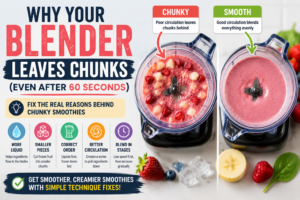
If your smoothie still contains fruit chunks after a full minute of blending, the problem is usually not just blender power. Chunky smoothies are often caused by poor circulation, frozen ingredient overload, incorrect loading order, or ingredient prep mistakes that prevent the blades from moving ingredients smoothly.
Many people assume blending longer automatically fixes texture problems. In reality, once circulation breaks down, extra blending time often does very little.
The good news is that most chunky smoothie problems can be fixed with better technique and ingredient balance.
Quick Fix for Chunky Smoothies
If your blender keeps leaving chunks behind, try these adjustments first:
- Add More Liquid
- Reduce Oversized Frozen Ingredients
- Start Blending At Lower Speeds
- Use Correct Ingredient Layering
- Avoid Overpacking The Jar
- Blend In Stages Instead Of Continuously
Small changes in circulation often improve smoothie texture immediately.
Table of Contents
Why Smoothies Stay Chunky
Smoothies usually remain chunky when ingredients stop circulating properly around the blades. Once movement inside the blender slows down, frozen fruit and heavier ingredients may sit above the blades without blending evenly.
This commonly happens with:
- Frozen Strawberries
- Frozen Mango Chunks
- Ice Cubes
- Thick Protein Smoothies
- Low-Liquid Recipes
Chunky texture is especially common in dense frozen smoothies because the ingredients create more resistance near the blades.
Poor Circulation Stops Ingredients From Reaching The Blades
Blenders rely on vortex circulation to continuously pull ingredients downward.
When circulation weakens, ingredients begin sticking to the sides or floating above the blade area. This often creates uneven blending where part of the smoothie becomes smooth while larger chunks remain trapped higher in the jar.
If your blender regularly struggles with circulation or ingredient movement, these frozen smoothie troubleshooting tips for stalled blending and uneven texture may help.
Frozen Fruit Is Often The Main Problem
Large frozen fruit pieces are one of the biggest causes of chunky smoothies.
Frozen strawberries and mango chunks are especially difficult because they become extremely hard in the freezer and do not break down easily without strong circulation.
Adding too many frozen ingredients at once can overwhelm even powerful blenders if the mixture lacks enough liquid flow.
Smaller frozen pieces usually blend much more evenly.
Incorrect Loading Order Creates Uneven Texture
Ingredient placement inside the blender matters more than many people realize.
If frozen ingredients sit directly against the blades before circulation starts, the blender may struggle to pull ingredients downward correctly. This increases the chances of trapped air pockets and stalled blending.
Loading liquids first usually improves circulation significantly.
Thick Smoothies Need Better Ingredient Balance
Very thick smoothies naturally create more resistance during blending.
Recipes heavy in:
- Protein Powder
- Nut Butter
- Oats
- Frozen Bananas
often need additional liquid or slower blending stages to maintain smooth circulation.
Without enough movement inside the jar, chunks can remain trapped even after extended blending.
Why Blending Longer Does Not Always Help
Once circulation breaks down, longer blending often creates more heat without improving texture.
This is one reason some smoothies remain chunky even after 60 seconds or more of blending. The blades may continue spinning while ingredients stop moving properly above them.
Fixing circulation usually matters far more than simply increasing blend time.
How To Get Smoother Smoothies
Add More Liquid Slowly
One of the easiest fixes for chunky smoothies is increasing liquid gradually.
Water, milk, almond milk, juice, yogurt, or coconut water can all help improve circulation around the blades.
Even small increases in liquid can dramatically improve ingredient movement.
Blend Frozen Ingredients In Stages
Instead of blending large frozen batches immediately, start slowly and increase speed gradually.
This gives the blender time to establish circulation before the mixture becomes too dense.
Cut Frozen Fruit Smaller
Smaller frozen fruit pieces blend much more efficiently than oversized chunks.
Pre-cut frozen fruit usually circulates better and reduces strain on the motor.
Use Correct Ingredient Layering
Liquids should normally go in first, followed by softer ingredients, greens, frozen fruit, and finally ice.
This layering method improves circulation and helps ingredients move more evenly around the blades.
Why Blender Design Affects Smoothie Texture
Some blenders naturally create smoother circulation than others. Blade angle, motor power, jar shape, and vortex strength all influence how effectively ingredients move during blending.
Stronger circulation usually produces a smoother texture with fewer unblended chunks.
If you are comparing smoothie machines for frozen fruit blending, smoother circulation, and thick recipe performance, explore these blender reviews for smoother smoothies and stronger frozen ingredient blending.
Best Blender Types For Reducing Smoothie Chunks
Some blenders are specifically better at handling frozen fruit and dense ingredients. The right blender can improve circulation, reduce stalling, and create a much smoother texture during heavy blending.
Smart Blenders For Smoother Frozen Texture
Some newer smart blenders maintain more consistent circulation because they automatically adjust blending speed during thicker recipes.
If you want a smart blender for a smoother frozen smoothie texture, the Vitamix Ascent X3 is designed for controlled circulation and smoother ingredient breakdown.
Budget Blenders For Frozen Fruit Smoothies
Affordable blenders can still perform well when ingredient balance and circulation are managed correctly.
If you need an affordable blender for frozen fruit and smoother smoothies, the Ninja BL660 remains a strong option for everyday frozen blending.
Powerful Blender Upgrades For Chunk Reduction
Some users continue experiencing chunky smoothies simply because their current blender lacks enough blending strength for dense frozen ingredients.
If you want a powerful blender upgrade for reducing smoothie chunks, the Chefman Obliterator is built for heavier blending and thicker recipes.
Common Smoothie Texture Mistakes
Many smoothie texture problems come from the blending technique instead of the blender’s failure. Using too little liquid, overpacking frozen ingredients, or skipping proper ingredient layering often creates uneven texture.
Another common mistake is blending thick smoothies at maximum speed immediately instead of allowing circulation to develop gradually. Small technique adjustments usually improve smoothie consistency dramatically.
Frequently Searched Questions
Why Is My Smoothie Still Chunky After Blending?
This usually happens because ingredients stop circulating correctly around the blades.
Why Does Frozen Fruit Stay In Chunks?
Large frozen fruit pieces often struggle to circulate without enough liquid flow.
Can A Weak Blender Cause Chunky Smoothies?
Yes. Lower-powered blenders may struggle with dense frozen ingredients and thick recipes.
Does More Liquid Make Smoothies Smoother?
Usually yes. Better liquid flow improves circulation and ingredient movement.
Why Does My Blender Spin But Leave Chunks?
This often means ingredients are trapped above the blades instead of circulating downward properly.
Does Blender Loading Order Matter?
Yes. Correct ingredient layering helps establish stronger circulation and smoother blending.
Final Thoughts
Chunky smoothies are usually caused by poor circulation, oversized frozen ingredients, incorrect loading order, or insufficient liquid balance. Small adjustments like improving ingredient layering, blending gradually, cutting frozen fruit smaller, and maintaining smoother circulation can dramatically improve texture consistency.
Understanding how ingredients move inside the blender helps create smoother frozen smoothies with fewer chunks, less stalling, and better overall blending performance.